



Choosing the right kitchen worktop involves much more than finding an attractive colour. The surface must cope with heat, spills, daily cleaning and years of regular use. For that reason, Dekton kitchen worktops in the UK have become an increasingly popular option for premium residential projects.
Manufactured by Cosentino, Dekton is an ultra-compact surface designed to combine durability with contemporary aesthetics. Its technical properties make it suitable for kitchen worktops, islands, splashbacks and even outdoor kitchens.
However, Dekton is a premium material. Therefore, homeowners should understand its advantages, limitations, costs and design options before choosing it.
The MyKitchenWorktop team supplies and installs Dekton worktops across London, Surrey and other areas of the UK. This guide explains the main points to consider before specifying Dekton for a new kitchen.
Request a quote to discuss a Dekton project with the MyKitchenWorktop team.
What Are Dekton Kitchen Worktops?
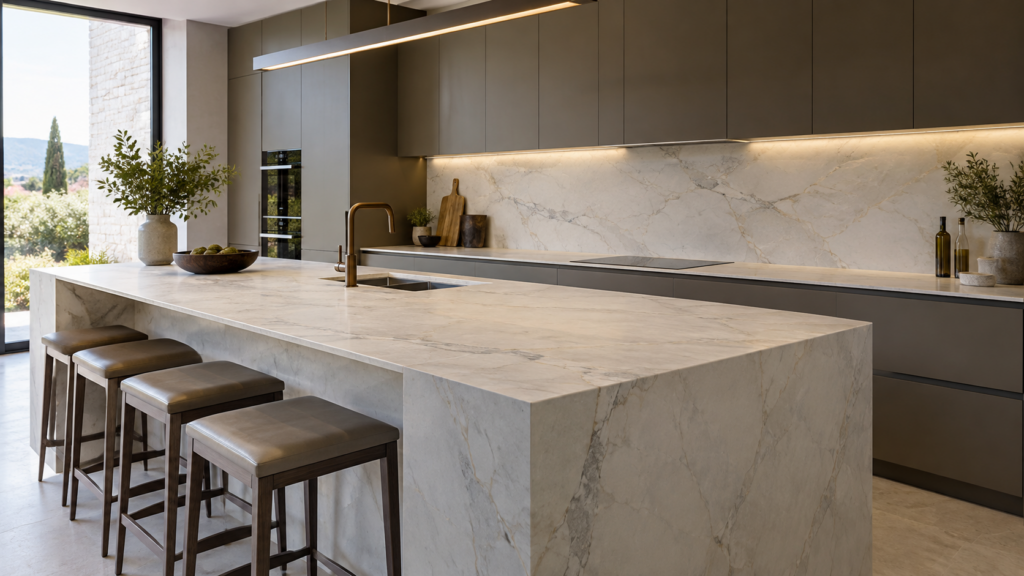
Dekton is an ultra-compact surface developed by Cosentino. It is manufactured from a sophisticated combination of natural minerals that undergo an advanced compaction and sintering process.
This manufacturing method creates a dense surface with extremely low porosity. As a result, Dekton offers excellent resistance to staining, scratching, abrasion and high temperatures.
Unlike traditional natural stones, Dekton does not require regular sealing. It also performs particularly well when exposed to sunlight and changing weather conditions.
These characteristics explain why Dekton kitchen worktops are frequently specified for modern kitchens, large islands and projects where durability is a priority.
Why Are Dekton Worktops Becoming So Popular in the UK?

Dekton kitchen worktops UK
Modern kitchens place significant demands on their worktops. Open-plan living has also changed the role of the kitchen island. It is now both a practical surface and an important architectural feature.
Dekton works particularly well in this environment.
Large-format slabs can create substantial worktop sections with fewer joints. In addition, the range includes marble-inspired surfaces, stone effects, concrete-style designs and restrained neutral colours.
The material can therefore suit both contemporary and more traditional interiors.
Its resistance to ultraviolet radiation provides another important advantage. Consequently, the same surface can continue from an indoor kitchen into an outdoor entertaining area without the colour stability concerns associated with some other engineered materials.
What Are the Main Advantages of Dekton Kitchen Worktops?

Dekton kitchen worktops UK
One of Dekton’s strongest characteristics is its resistance to heat.
A kitchen worktop sits close to ovens, induction hobs and hot cookware. Dekton’s mineral composition and manufacturing process allow it to tolerate high temperatures considerably better than many resin-based surfaces.
Scratch resistance is another important advantage. Everyday kitchen activity is unlikely to mark the surface easily.
Dekton also has extremely low porosity. Wine, coffee, cooking oils and many common household liquids remain on the surface rather than penetrating deeply into the material. Cleaning is therefore straightforward in normal domestic use.
Furthermore, Dekton does not need periodic sealing.
Its UV stability also makes it particularly useful for outdoor kitchen worktops. Sunlight has much less effect on the colour than it can have on some alternative engineered surfaces.
These properties make Dekton especially attractive for busy kitchens where appearance and performance are equally important.
Are There Any Disadvantages to Dekton Worktops?

No kitchen surface is completely indestructible.
Dekton is extremely hard, but that hardness also means fabrication requires specialised equipment and experience. Poor handling or incorrect fabrication can increase the risk of edge damage.
Strong impacts against exposed edges can also cause chips. Therefore, careful edge design and professional installation remain important.
Price is another consideration. Dekton normally sits within the premium section of the worktop market. Material choice, slab usage, edge profiles, access and fabrication complexity can all affect the final quotation.
For this reason, comparing Dekton purely on the cost of a slab can be misleading. The complete project should include templating, fabrication, cut-outs, delivery and installation.
How Much Do Dekton Worktops Cost in the UK?
There is no single Dekton worktop price in the UK because every project is different.
Several factors determine the final cost. These include the selected Dekton design, slab thickness, kitchen dimensions, number of slabs required and complexity of fabrication.
Sink and hob cut-outs also influence the quotation. Likewise, waterfall ends, mitred edges and unusually large kitchen islands require additional fabrication.
Current UK market guides commonly place installed Dekton within the premium worktop category. However, broad price-per-square-metre figures should only be treated as an indication.
A detailed drawing or set of kitchen dimensions provides a much more accurate basis for comparison.
MyKitchenWorktop can assess the layout, selected Dekton colour and required edge details before preparing a project-specific quotation.
Request a quote for an accurate Dekton price based on the actual kitchen design.
Dekton Colours and Finishes

One of Dekton’s major strengths is its design range.
Homeowners are no longer limited to plain contemporary surfaces. The collection now covers numerous visual styles.
White and cream designs work particularly well in bright kitchens. Meanwhile, darker black and charcoal surfaces can create dramatic islands or contrast with pale cabinetry.
Marble-inspired designs provide another option for clients who want pronounced veining without choosing natural marble.
There are also surfaces inspired by concrete, limestone and other natural stones.
Collections such as Onirika demonstrate how strongly Dekton has moved towards statement marble effects and expressive veining.
Different textures further expand the possibilities. Depending on the selected design, Dekton surfaces can feature matt, polished, textured or velvet-style finishes.
This variety allows the worktop to become part of the overall architectural design rather than simply a functional surface.
Which Dekton Thickness Is Best for a Kitchen Worktop?
Dekton is available in several thicknesses, and the appropriate choice depends on the application.
Slimmer slabs can create a minimalist appearance. They can also work effectively for furniture cladding and splashbacks.
For kitchen worktops, 12 mm and 20 mm surfaces offer considerable design flexibility. Meanwhile, specific projects may use other thicknesses depending on the support structure and intended edge detail.
A mitred edge can also create the appearance of a much thicker worktop without using a solid slab of the same visual depth.
This technique is particularly effective on kitchen islands and waterfall ends.
However, thickness should never be selected on appearance alone. Cabinet construction, spans, overhangs, cut-outs and support requirements must also be considered.
Professional templating and fabrication therefore play an important role in every installation.
Dekton vs Quartz: What Is the Difference?

Dekton and quartz are both popular premium kitchen surfaces, but their composition differs significantly.
Engineered quartz traditionally contains mineral quartz combined with binders and resins. Dekton, by contrast, is an ultra-compact mineral surface produced through high-pressure and high-temperature processing.
This difference affects performance.
Dekton offers particularly strong heat and UV resistance. It is therefore suitable for outdoor projects where conventional quartz may not be recommended.
Quartz remains an excellent option for indoor kitchens and offers an enormous range of colours and patterns. It may also provide different fabrication and pricing options.
Consequently, neither material should be selected from a specification sheet alone. Lifestyle, location, design and budget should all influence the decision.
MyKitchenWorktop also provides a detailed comparison of quartz, granite and Dekton for homeowners who want to explore these differences further.
Dekton kitchen worktops UK
Is Dekton Suitable for Outdoor Kitchens?
Outdoor use is one of the areas where Dekton has a significant advantage.
Its resistance to ultraviolet radiation means it can cope with prolonged exposure to daylight without the same concerns about fading that apply to some engineered surfaces.
It also tolerates temperature changes, rain and general weather exposure.
For this reason, Dekton can be used for garden kitchens, barbecue areas, external bars and outdoor entertaining spaces.
Using the same Dekton design indoors and outdoors can also create strong visual continuity between the kitchen and garden.
Dekton kitchen worktops UK
Is Dekton Worth Choosing in 2026?
For homeowners seeking a premium surface with excellent technical performance, Dekton remains a strong option.
Its heat resistance, very low porosity, scratch resistance and UV stability make it particularly suitable for demanding kitchens.
The range of colours and finishes has also developed considerably. Therefore, choosing Dekton no longer means accepting an exclusively minimalist or industrial appearance.
Nevertheless, fabrication quality is critical.
A premium material deserves accurate templating, experienced fabrication and professional installation. These elements influence both the final appearance and the long-term performance of the worktop.
The MyKitchenWorktop team can help clients compare Dekton colours, thicknesses, finishes and edge options before the project enters fabrication.
For homeowners planning Dekton worktops in London, Surrey or elsewhere in the UK, expert advice at the specification stage can prevent expensive changes later.
Request a quote and speak to the MyKitchenWorktop team about a Dekton kitchen worktop tailored to the dimensions, design and practical requirements of the project.
Frequently Asked Questions About Dekton Worktops
Does Dekton need sealing?
Dekton has extremely low porosity and does not normally require the periodic sealing associated with some natural stones.
Can Dekton be used around a hob?
Yes. Its strong resistance to heat makes Dekton particularly suitable for areas around hobs and other high-temperature kitchen zones.
Can Dekton be used outdoors?
Yes. Its UV and weather resistance make it one of the premium surface options suitable for outdoor kitchens.
Is Dekton easy to clean?
Routine cleaning is generally simple. Warm water and an appropriate mild cleaner are sufficient for most everyday kitchen maintenance.
Can Dekton chip?
Although Dekton is highly resistant to scratching and abrasion, heavy impacts can damage exposed edges. Correct fabrication, edge specification and professional installation help minimise this risk.
Where can Dekton worktops be installed in the UK?
MyKitchenWorktop supplies and installs premium worktops for projects across London, Surrey and other areas of the UK. Each project can be assessed individually according to location, dimensions and installation requirements.
Dekton kitchen worktops UK


