


Travertine worktops can be practical in a UK kitchen, but only for homeowners who value natural character and accept careful maintenance. This limestone has warm tones, linear movement and distinctive pores. However, it is softer and more acid-sensitive than quartz, granite or porcelain. A suitable slab, appropriate filling, professional sealing and prompt cleaning all matter. For a busy household seeking the easiest possible surface, an engineered alternative may make more sense. For a considered kitchen where patina is welcome, travertine can create a refined result that manufactured patterns cannot fully reproduce.
Quick answer: who should choose travertine?
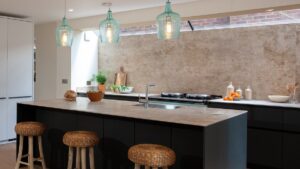
Travertine worktops suit a homeowner who wants an authentic, softly textured natural stone and understands that its appearance will evolve. They work particularly well in warm neutral kitchens, calm contemporary schemes and interiors influenced by Mediterranean architecture.
It is less suitable for anyone who expects a perfectly uniform, highly stain-resistant or maintenance-free worktop. Before choosing it, the client should view the actual slab and discuss the finish, filled areas, sealing and daily care with the fabricator.
What are travertine worktops?

Travertine is a sedimentary limestone formed by mineral deposits around springs and other water sources. Its small holes and channels give the stone a recognisable structure. Depending on how the block is cut, the pattern may appear linear and directional or softer and more cloud-like.
For worktop use, the open areas are commonly filled and the surface is finished to make everyday cleaning more manageable. Even so, travertine remains a calcareous natural stone. Therefore, acids such as lemon juice, vinegar and some cleaners can dull or etch the finish.
The travertine worktop collection at MyKitchenWorktop includes cream, brown, grey and red options. Because each slab varies, online photographs should guide the shortlist rather than replace slab selection.
What are the main benefits of travertine worktops?

Warm, genuine natural character
Travertine has depth that comes from real mineral formation rather than a printed pattern. Gentle tonal changes, pores and linear bands can soften handleless cabinetry and add warmth to minimalist kitchens. It also pairs naturally with oak, painted timber, aged brass and textured plaster.
A choice of cuts and finishes
Vein-cut travertine shows long, graphic bands. Cross-cut stone has a more open, mottled pattern. A honed finish usually gives the surface a quieter, contemporary appearance, while a polished finish reflects more light. The right option depends on the slab and the intended use.
For example, the current Travertine Silver listing shows a grey vein-cut surface in honed and polished finishes. It lists 20 mm and 30 mm options. Availability should always be confirmed against the current batch before specification.
Design continuity beyond the worktop
The same family of stone can connect a worktop with a splashback, vanity, fireplace or selected floor detail. However, every application needs its own technical assessment. Matching does not mean every piece should use the same thickness, finish or treatment.
For help comparing slabs and planning the whole scheme, Request your quote from MyKitchenWorktop.
What are the limitations?
Acid sensitivity
Because travertine contains calcium carbonate, acidic substances can react with the stone. This may create an etch mark, which is a change in sheen rather than an ordinary stain. Sealers can reduce liquid absorption, but they do not make a calcareous stone acid-proof.
Porosity and filled areas
Travertine naturally contains voids. Fillers help create a more usable surface, yet the quality and appearance of filled areas should be assessed carefully. Over time, a local repair may be needed if filling becomes damaged. The chosen slab also needs suitable support around sinks, hobs and narrow sections.
Variation and patina
Colour, pore structure and movement vary between slabs and batches. This individuality is part of the appeal, but it can frustrate a client seeking exact visual consistency. Minor marks and changes in sheen may also become part of the surface over time.
These limitations do not make travertine a poor material. Instead, they mean travertine worktops need the right owner, fabrication plan and expectations. MyKitchenWorktop’s guide to choosing a worktop for a particular lifestyle can help frame that decision.
Travertine vs quartz and porcelain

| Decision factor | Travertine | Quartz | Porcelain |
|---|---|---|---|
| Appearance | Natural pores, tonal variation and unique movement | Controlled colour with a broad choice of engineered patterns | Consistent designs, often with a slim architectural look |
| Daily care | Prompt cleaning, pH-neutral products and sealing as advised | Generally low maintenance; follow the brand’s care guidance | Low porosity and straightforward daily cleaning |
| Acid response | Sensitive to acidic food and cleaners | More forgiving for common spills, but not damage-proof | Good resistance for normal kitchen use |
| Best suited to | Clients who prioritise natural character and accept patina | Busy kitchens seeking consistency and easier care | Contemporary projects prioritising a slim look and low upkeep |
The best alternative depends on the priority. Compared with engineered surfaces, travertine worktops offer more geological variation but need more attentive care. Quartz worktops provide consistent patterning and simple care. Meanwhile, ceramic and porcelain worktops suit projects where low porosity and a contemporary profile matter.
How should travertine be specified for a kitchen?
First, view the full slab rather than relying on a small sample. Check the direction of movement, the position of larger voids and how adjoining pieces may align. For an island or long run, agree the seam position before fabrication.
Next, choose the finish with daily use in mind. Honed stone can create a soft, modern effect, while polished stone appears more reflective. The fabricator should explain how the selected finish may show etching, fingerprints and wear.
Finally, discuss edge profiles, cut-outs and support. Travertine is not the material for improvised fabrication or unsupported projections. Sink rails, hob cut-outs and overhangs require a project-specific assessment. A mitred edge can create a thicker appearance, although its joins and vein direction need precise planning.
To review slab options, fabrication details and alternatives for a London or UK project, Request your quote.
How do you care for travertine worktops?
- Blot spills promptly, especially wine, citrus, vinegar, tomato and oil.
- Use a soft cloth with warm water and a pH-neutral stone cleaner.
- Avoid acidic, abrasive or strongly alkaline cleaning products.
- Use chopping boards, coasters and trivets rather than working directly on the stone.
- Follow the fabricator’s sealing advice for the exact slab and finish.
- Ask a stone professional to assess deep marks, damaged filler or persistent stains.
There is no reliable universal resealing interval. Stone density, finish, sealer, cleaning habits and kitchen use all affect performance. A professional should assess the surface instead of applying unnecessary products on a fixed calendar.
What affects the cost of a travertine worktop?
The slab is only one part of the quotation for travertine worktops. Colour, block selection, usable yield and batch availability can influence material cost. Fabrication then depends on the layout, thickness, edge detail, sink and hob cut-outs, drainage grooves, upstands and splashbacks.
Access and installation also matter, particularly in London properties with restricted parking, narrow stairs or upper floors. For this reason, a price per square metre rarely describes the complete installed project. Accurate drawings and a clear specification produce a more useful comparison.
Frequently asked questions
Do travertine worktops stain easily?
They can absorb coloured or oily liquids if the surface is not suitably protected or a spill remains. Appropriate sealing and prompt blotting reduce the risk, but neither prevents every mark.
Can a hot pan go directly on travertine?
A trivet should be used. Although stone tolerates warmth, direct cookware can create thermal stress, mark filler or affect treatments. A simple barrier also protects the surrounding finish.
Is honed or polished travertine better for a kitchen?
Neither finish is universally better. Honed travertine looks softer and may make changes in sheen less prominent. Polished travertine reflects more light but can show etching differently. The actual slab should guide the choice.
Are travertine worktops suitable for busy family kitchens?
They can work when the household accepts prompt cleaning, protective accessories and gradual patina. Where very low maintenance is the priority, quartz or porcelain will often be the more practical option.
Are travertine worktops the right choice?
Travertine worktops reward informed selection. They offer warmth, natural movement and individuality, yet they also need more care than many engineered surfaces. The best projects match the stone to the household, inspect the actual slab and resolve fabrication details before templating.
MyKitchenWorktop can compare travertine with quartz, porcelain and other premium surfaces for the same brief. Request your quote to discuss the layout, finish, maintenance expectations and current slab options.
Transparency note: This article was prepared with AI assistance and reviewed before publication.