




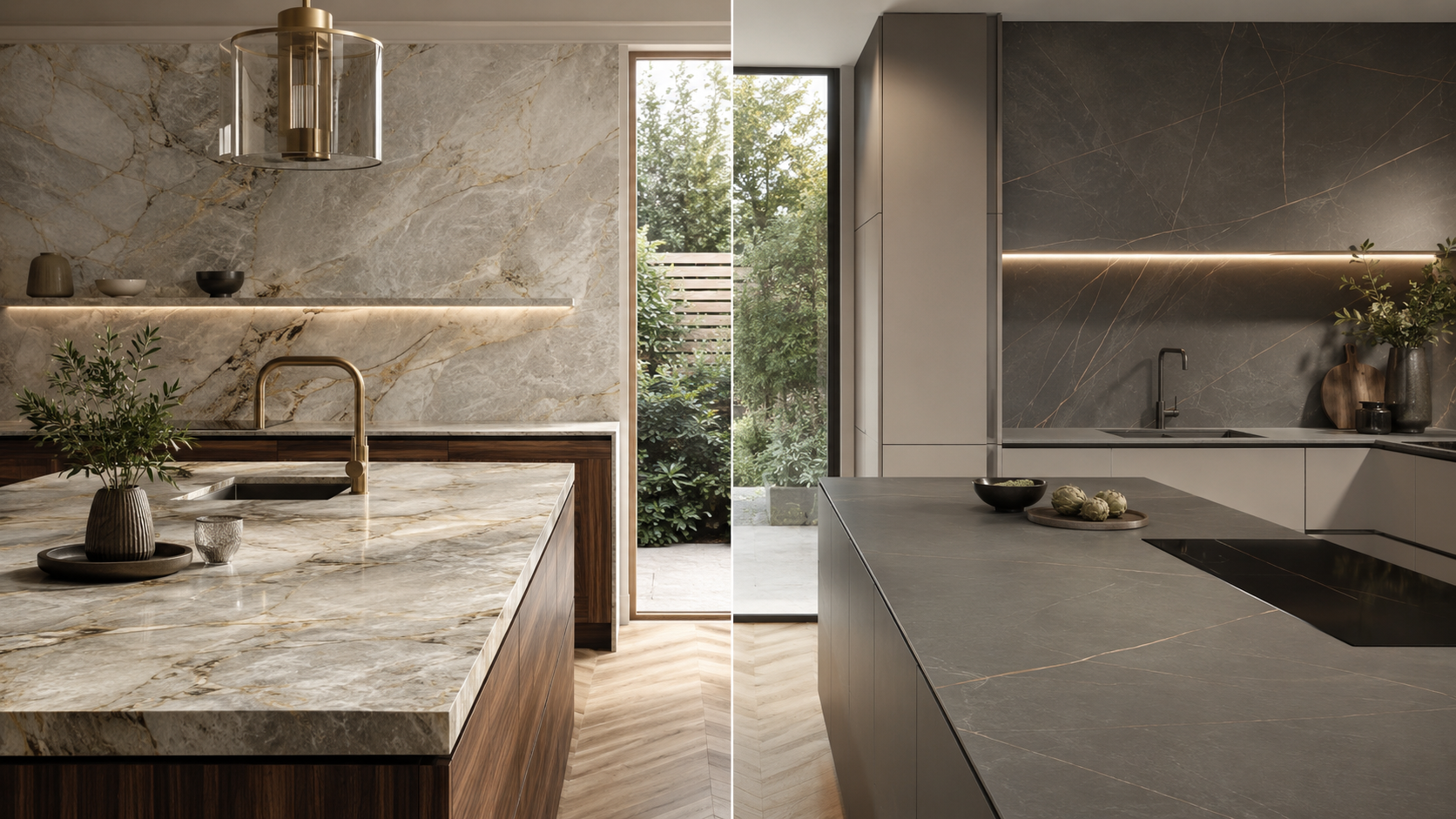
Author: Jesús Alberto Mouzo, CEO of MKW. In this article, we will explore Quartzite vs Porcelain Worktops: Which Luxury Surface Is Best for UK Kitchens in 2026?
If a kitchen renovation is already being planned, this guide can help clarify which material fits best. For tailored advice, Request a cuote and the MyKitchenWorkTop team can recommend the most suitable surface for each space.
Why Compare Quartzite and Porcelain Worktops in 2026?

Luxury kitchen design in 2026 is moving towards surfaces that combine visual impact with technical performance. Homeowners want kitchens that look refined, but they also expect materials that can deal with daily cooking, family life, entertaining, cleaning, and long-term use.
This is where quartzite and porcelain worktops stand out. Quartzite appeals to those who want the depth, movement, and exclusivity of natural stone. Porcelain, also known as sintered stone in many collections, attracts customers looking for a sleek, modern, low-maintenance surface with strong resistance to heat, stains, and UV exposure.
Both materials belong in the premium worktop category. However, they do not offer the same experience. Quartzite feels organic, unique, and naturally luxurious. Porcelain feels precise, architectural, and technically advanced.
For that reason, comparing quartzite vs porcelain worktops is not only useful. It is necessary before investing in a new kitchen surface.
What Are Quartzite Worktops?

Quartzite is a natural stone formed under intense heat and pressure. It begins as sandstone and transforms over time into a dense, strong, and visually striking material. This geological process gives quartzite its unique character, making every slab different.
One of the main reasons quartzite worktops are so desirable is their natural beauty. Many quartzite slabs offer soft veining, crystalline depth, and colours that can resemble marble. However, quartzite is generally harder and more resistant than many marble surfaces, which makes it attractive for kitchen use.
In luxury interiors, quartzite is often chosen for statement kitchen islands, elegant family kitchens, open-plan living spaces, and projects where the worktop is expected to become a central design feature.
Because every slab is unique, quartzite is ideal for homeowners who do not want a surface that looks mass-produced. It brings personality, movement, and natural exclusivity into the kitchen.
Anyone considering a bespoke natural stone kitchen can Request a cuote to explore quartzite options available through MyKitchenWorktop.
What Are Porcelain Worktops?

Porcelain worktops are engineered surfaces produced using natural minerals, high pressure, and high temperatures. They are often associated with sintered stone technology, where raw materials are compacted and fired to create a dense, durable slab.
This manufacturing process gives porcelain excellent technical properties. It can offer strong resistance to heat, scratching, staining, moisture, and UV light. As a result, porcelain is widely used in modern kitchens, bathrooms, splashbacks, wall cladding, outdoor kitchens, and contemporary architectural interiors.
Porcelain also gives designers a wide visual range. It can replicate marble, concrete, stone, metal, and minimalist solid colours. For homeowners who want a clean, modern, and consistent surface, porcelain is a very strong candidate.
Unlike quartzite, porcelain does not depend on natural slab variation in the same way. That can be an advantage when a project requires more visual control, bookmatched panels, consistent colour, or a more architectural finish.
Quartzite vs Porcelain Worktops: Appearance and Design

The biggest difference between quartzite and porcelain is the visual experience.
Quartzite offers natural depth. Its veining, mineral structure, and tonal variation cannot be perfectly repeated. This gives every project a sense of individuality. In a luxury kitchen, that can be a major advantage. A quartzite island can become a piece of natural art, especially when paired with carefully designed lighting, premium cabinetry, and refined edge detailing.
Porcelain, on the other hand, offers precision. Its patterns can be dramatic, subtle, industrial, or minimalist. It is particularly effective in contemporary kitchens where large-format surfaces, slim profiles, full-height splashbacks, and clean lines are important.
For a classic luxury kitchen, quartzite often feels warmer and more organic. For a modern architectural kitchen, porcelain often feels sharper and more controlled.
There is no universal winner here. The better choice depends on the atmosphere the kitchen needs to create.
Durability: Which Material Performs Better?

Both quartzite and porcelain are durable materials, but they perform differently.
Quartzite is naturally hard and strong. It is suitable for busy kitchens and can handle everyday use well when properly selected, fabricated, sealed, and maintained. However, as a natural stone, it still requires professional handling and appropriate care. Sealing may be recommended depending on the slab, finish, and level of use.
Porcelain is extremely resistant in many practical areas. It is non-porous, highly resistant to stains, and performs well against heat and UV exposure. This makes it appealing for homeowners who want a low-maintenance kitchen surface with strong technical reliability.
However, porcelain also requires expert fabrication. Its edges and cut-outs must be handled carefully by experienced professionals. Poor installation can compromise the final result, especially around sinks, hobs, corners, and large-format pieces.
In simple terms, quartzite is naturally strong and luxurious. Porcelain is technically advanced and highly practical.
For homeowners comparing durability in a real kitchen setting, MyKitchenWorktop can assess the project and recommend the correct material. Request a cuote for project-specific guidance.
Maintenance: Which Worktop Is Easier to Live With?

Maintenance is often one of the deciding factors when choosing a kitchen worktop.
Porcelain is usually easier to maintain. Its dense, non-porous surface helps resist staining and moisture. It does not usually require sealing, and routine cleaning is straightforward. This makes porcelain a strong choice for busy households, rental properties, second homes, and kitchens used heavily every day.
Quartzite requires a more natural stone approach. It is not difficult to maintain, but it benefits from the right care. Depending on the specific slab, sealing may be recommended to help protect the surface. Harsh chemicals should be avoided, and spills should be cleaned promptly, especially acidic liquids or strongly coloured substances.
For customers who love natural stone and are comfortable with simple care routines, quartzite remains an excellent choice. For those who want the lowest possible maintenance, porcelain may be more practical.
Heat, Stains, and Scratches
In modern kitchens, surfaces are expected to perform. Cooking, serving, cleaning, and entertaining all put pressure on the worktop.
Porcelain has a strong reputation for heat resistance, stain resistance, and scratch resistance. It is often selected for this reason. It performs particularly well in contemporary kitchens where the worktop must remain visually clean with minimal effort.
Quartzite also offers impressive strength and heat resistance compared with many other natural stones. However, protective habits are still recommended. Trivets, chopping boards, and gentle cleaning products will help preserve the beauty of the surface over time.
In practice, both materials can work beautifully in luxury kitchens. The difference is that porcelain leans more towards technical convenience, while quartzite leans more towards natural prestige.
Cost and Long-Term Value
Quartzite and porcelain both sit within the premium kitchen worktop market. The final cost depends on the selected slab, brand, thickness, finish, fabrication complexity, edge profile, templating, installation, splashbacks, and project location.
Quartzite can be more expensive when rare slabs, dramatic veining, or complex fabrication are involved. However, its uniqueness can add strong perceived value to a luxury kitchen. For high-end residential projects, this natural exclusivity is often part of the appeal.
Porcelain can also vary significantly in price. Premium porcelain and sintered stone brands, large-format slabs, bookmatched designs, and complex installations can all increase the investment. Its value lies in performance, design consistency, and low maintenance.
For resale appeal, both materials can support a premium kitchen design. Quartzite may appeal more to buyers looking for natural luxury. Porcelain may appeal more to buyers looking for practicality, modern aesthetics, and durability.
The best way to compare costs accurately is not by material name alone. It is by project specification. Request a cuote and the MyKitchenWorktop team can prepare a more accurate estimate based on the kitchen layout and chosen surface.
Best Uses for Quartzite Worktops
Quartzite is especially suitable for kitchens where the surface needs to create visual emotion. It works beautifully in large islands, luxury open-plan kitchens, classic interiors, and spaces where natural veining is part of the design story.
It is also a strong option for homeowners who want a material that feels exclusive. Since each slab is different, quartzite can make a kitchen feel more personal and bespoke.
Quartzite is particularly effective when paired with neutral cabinetry, brass details, timber finishes, soft lighting, and carefully chosen splashbacks. It can also work well in contemporary spaces when the design allows the stone to become the main feature.
Best Uses for Porcelain Worktops
Porcelain is ideal for modern, minimal, and highly practical kitchens. It works well in projects where clean lines, slim profiles, large slabs, and matching splashbacks are required.
It is also a strong option for family kitchens, busy homes, and spaces where low maintenance is a priority. Because porcelain can resist moisture, stains, UV exposure, and heat, it is often used beyond the kitchen worktop itself.
Porcelain is particularly effective for full-height backsplashes, waterfall islands, outdoor kitchens, bathroom surfaces, wall cladding, and coordinated interior schemes.
For homeowners who want a refined but practical material, porcelain offers one of the strongest combinations available in 2026.
Quartzite vs Porcelain: Which One Should Homeowners Choose?
The answer depends on priorities.
Choose quartzite if the project needs natural beauty, unique veining, organic depth, and a sense of exclusivity. It is the better choice for homeowners who want a luxury kitchen surface with individuality and character.
Choose porcelain if the project needs low maintenance, technical resistance, modern design flexibility, and consistent performance. It is the better choice for homeowners who want a sleek, durable, and practical surface for daily life.
Both materials can create a premium kitchen. The mistake would be choosing based only on appearance. A worktop must suit the way the kitchen will be used every day.
That is why professional advice matters. At MyKitchenWorktop, the team can compare quartzite and porcelain options according to the kitchen layout, lifestyle, colour palette, edge profile, splashback design, and installation requirements.
For a personalised recommendation, Request a cuote and discover which material is best suited to the project.
Final Verdict: Quartzite or Porcelain?
Quartzite and porcelain are two of the most desirable luxury kitchen worktop materials for UK homes in 2026. Quartzite delivers natural stone beauty, exclusivity, and a timeless premium feel. Porcelain delivers advanced performance, easy maintenance, and contemporary design freedom.
For a kitchen where the worktop must become a statement feature, quartzite is difficult to beat. For a kitchen where practicality and modern precision are the main priorities, porcelain is an outstanding choice.
The best decision is the one that balances beauty, performance, budget, and lifestyle. With the right material and expert installation, both quartzite and porcelain can transform a kitchen into a refined, durable, and valuable space.
MyKitchenWorktop supplies and installs premium worktops across London and the UK. To compare suitable materials, finishes, colours, and installation options, Request a cuote today.
Transparency note: This article was prepared with AI assistance and reviewed before publication.


