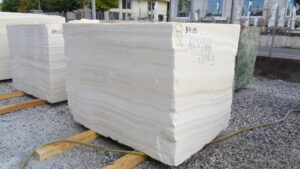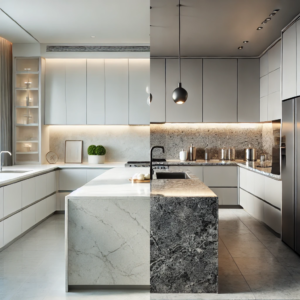



A Bianco Drift quartz worktop suits kitchens that need a soft grey, marble-inspired surface without the routine sealing associated with many natural stones. Moreover, its pale background and restrained veining can complement contemporary handleless cabinetry, traditional painted units and timber finishes. However, buyers should confirm current slab formats, finishes and availability before finalising a design.
MKW can help clients compare samples, plan cut-outs and assess edge details before providing a project-specific quotation. For the original product reference, see Bianco Drift quartz surfaces.

Bianco Drift quartz worktop at a glance
Caesarstone Bianco Drift, which Caesarstone also identified as 6131 Bianco Drift, has a light grey background with subtle movement inspired by marble and quartzite. For context, the original article compared its character with Fiori di Pesco, Emperador Grey, Mother of Pearl and Taj Mahal. However, these materials vary considerably, so a physical sample offers a more dependable basis for comparison.
Engineered quartz generally provides a more consistent pattern than natural marble. In addition, it does not need the routine sealing that many porous stones require. Nevertheless, no worktop is stain-proof, scratch-proof or immune to damage. Therefore, owners should clean spills promptly and protect the surface during everyday use.

Pale marble-effect surface used on a worktop.
Designing with Bianco Drift quartz
The neutral grey palette makes a Caesarstone Bianco Drift worktop adaptable. Rather than dominating the room, it can connect cabinet colours, flooring and metal finishes. However, daylight, artificial lighting and the amount of visible surface will influence its final appearance. Therefore, MKW recommends viewing a representative sample in the intended room.
Cabinet and colour combinations
- White or off-white cabinets: create a bright scheme, while the grey detail prevents the worktop from appearing completely plain.
- Charcoal or dark blue units: provide stronger contrast and make the pale surface a focal point.
- Natural timber: adds warmth and, therefore, can balance the cooler grey background.
- Soft grey cabinetry: produces a calm tonal interior. However, clients should compare samples carefully to avoid clashing undertones.

A pale veined surface used across a kitchen island.
Bianco Drift quartz splashbacks and upstands
Using the same surface for a worktop and splashback can create a coordinated finish with fewer competing materials. Alternatively, a short upstand can provide a restrained transition to paint, tiles or another wall finish. For further guidance, the guide to kitchen worktop upstands explains where this detail can prove useful.
Vein alignment deserves early attention, especially across an island, full-height splashback or downstand. Although engineered patterns offer more consistency than many natural stones, every cut still affects the visual flow. Therefore, the templating and fabrication plan should consider focal areas as well as material efficiency.

Edges, islands and worktop joints
A slim edge can reinforce a contemporary design, while a built-up or mitred edge creates a more substantial island. For example, the original article showed 30 mm worktops, a rounded detail, a 40 mm mitred edge and a butt-jointed downstand. However, these examples illustrate design possibilities rather than guaranteed current fabrication options.
Joints may become necessary because of slab dimensions, access routes, appliance cut-outs or the shape of the room. Consequently, clients should discuss their position during the design stage. For more detail, MKW’s guide to planning kitchen worktop joints covers the main considerations.

Veined surface used for a table or island application.
Clients considering a Bianco Drift quartz worktop can request a quotation based on plans or provisional measurements. However, accurate pricing must account for the layout, finished edges, cut-outs, access and installation requirements rather than surface area alone.
How a Bianco Drift quartz worktop performs
Quartz offers a low-maintenance alternative to many marble surfaces. In particular, everyday acidic foods are less likely to cause the dull etching associated with calcium-based natural stone. Nevertheless, resin-bound quartz still requires sensible use.
- First, use chopping boards rather than cutting directly on the surface.
- In addition, place trivets beneath hot pans, oven trays and heat-producing appliances.
- Moreover, wipe away oils, wine, coffee and strongly coloured ingredients promptly.
- Likewise, avoid sitting or standing on unsupported sections and vulnerable edges.
- Finally, do not expose the surface to harsh chemicals unless the manufacturer approves them.

Pale veined island with a deep mitred or waterfall-style edge.
Quartz often suits kitchen worktops, islands, utility rooms, vanity tops and selected vertical applications. Even so, exposure, support and the manufacturer’s technical guidance can affect suitability. For example, clients should not assume that a kitchen slab specification automatically suits exterior areas, floors or every fireplace application.
How to care for Caesarstone Bianco Drift
For routine cleaning, remove crumbs and grit before wiping the surface with a soft cloth, warm water and a mild cleaner suitable for quartz. Afterwards, dry it with a clean cloth to reduce streaks. However, abrasive pads may alter the sheen, so owners should avoid them unless current manufacturer guidance specifically allows their use.
If a dried deposit remains, soften it first rather than scraping aggressively. Moreover, test any specialist product in an inconspicuous place and follow its directions. For additional ownership advice, the broader quartz worktop guide covers material characteristics and routine maintenance.

Matching pale worktop and wall surface in a coordinated kitchen scheme.
Bianco Drift quartz specifications to verify
According to the original article, Caesarstone’s engineered-quartz history dates to 1987. In addition, that article placed Bianco Drift in the Classico collection and listed the details below. However, ranges, finishes, warranties and slab formats can change. Therefore, clients should treat these figures as archived information and request a current supplier confirmation or manufacturer data sheet.
| Product reference | 6131 Bianco Drift |
|---|---|
| Collection stated in the original article | Classico |
| Archived slab dimensions | 3,060 mm by 1,440 mm |
| Archived thickness listing | 13 mm, 20 mm, 25 mm and 30 mm |
| Archived finish listing | Polished, honed and textured |
| Archived slab weights | 13 mm: 143 kg (32 kg/m2); 20 mm: 220 kg (50 kg/m2); 30 mm: 330 kg (75 kg/m2) |
| Original edge note | The original article recommended a minimum radius of 3–4 mm for edge profiles. |

Island with a pale veined surface and a butt-jointed downstand.
The original article also referred to an authenticity stamp beneath each slab and a ten-year product warranty following registration. Nevertheless, buyers should confirm the warranty term, registration process, permitted applications and care conditions at the time of purchase.
What to check before ordering
First, clients should view a current sample and confirm that its undertones complement the cabinets, flooring and wall colours. Next, they should identify every sink, hob, tap and socket cut-out on the plan. In addition, the quotation should state the required edges, upstands, splashbacks and downstands.
Access also needs careful planning because large worktop sections can prove difficult to move through narrow doors, stairs or corridors. Consequently, clients should share photographs of the route before templating. Finally, the fabricator should review support around cut-outs, overhangs and appliance openings.
Request a Bianco Drift worktop quotation
Before ordering, clients should provide a plan showing approximate dimensions, sink and hob cut-outs, edge preferences and any upstands or splashbacks. In addition, photographs can help the team identify access constraints and unusual support requirements. However, MKW will confirm final details after templating and fabrication review.
For advice or a tailored quotation, contact MKW on 0203 0788921 or email [email protected]. Alternatively, use the protected reference here for existing manufacturer information. Finally, MKW thanks Caesarstone for the original article images.
Frequently asked questions
Is Bianco Drift quartz the same as marble?
No. Instead, it is an engineered quartz surface with a marble-inspired appearance. Therefore, its composition, pattern consistency and care requirements differ from those of natural marble.
Does a Bianco Drift quartz worktop need sealing?
Engineered quartz does not normally require routine sealing. However, owners should follow the current care guidance that the supplier or manufacturer provides for their surface.
Can Caesarstone Bianco Drift form a splashback?
The original article showed matching splashback and vertical applications. Even so, the fabricator should confirm current technical suitability, dimensions, joints and installation requirements for the proposed location.
Should a buyer choose quartz or natural marble?
Quartz generally suits buyers who prioritise consistent patterning and straightforward maintenance. By contrast, marble offers unique natural variation but usually needs more careful protection from acids and staining. Therefore, the best choice depends on the desired appearance and acceptable level of upkeep.