




Carrara marble worktop care starts with three simple habits. Wipe spills promptly, use gentle cleaning products and protect the surface during food preparation. These steps will not make marble maintenance-free. However, they can reduce stains, scratches and dull etched patches.
Carrara marble has a long history in architecture, sculpture and interior design. In kitchens, its pale background and grey veining create a distinctive natural surface. Also, every slab has individual variations in colour and pattern. Many London projects feature Carrara marble. However, owners should remember that natural marble worktops need attentive care.
Marble is a porous metamorphic stone made predominantly from calcite. Therefore, an inadequately sealed surface may absorb liquids. Acids can also react with the stone itself. Consequently, marble often needs more care than Caesarstone quartz surfaces, Silestone or a Granite worktop. Even so, good daily habits can help it age gracefully.

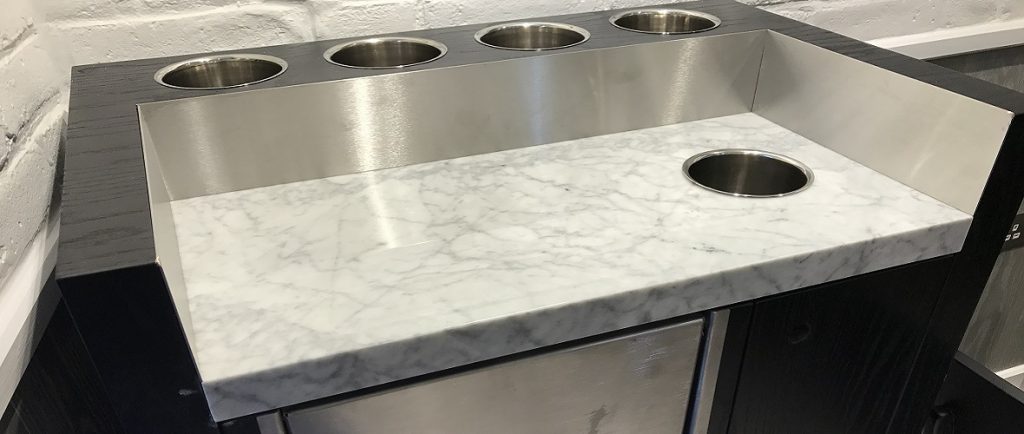
Bianco Carrara marble with 50 mm mitred front edges, installed by My Kitchen Worktop for La Casa Di Stefano on Regent Street, London.
Carrara marble worktop care: seven practical tips
The correct routine depends on the stone, finish and existing sealer. Nevertheless, the following principles suit most domestic Carrara marble surfaces. Where fabricators provide different instructions, owners should follow that project-specific guidance.
1. Blot spills promptly
If liquid reaches the marble worktop, blot it promptly with a clean, absorbent cloth. Avoid wiping large spills from side to side, as this can spread them. Instead, work from the outer edge towards the centre. Afterwards, clean the area gently and dry it.
Wine, coffee, tea, oils and colourful sauces may leave stains. Therefore, prompt action matters. Acidic substances also need immediate attention. For example, lemon juice, vinegar, tomatoes and fizzy drinks can etch calcite.
2. Follow a gentle daily cleaning routine
First, remove loose crumbs that might scratch the surface. Then use warm water and a soft microfibre cloth. Alternatively, choose a cleaner specifically labelled as suitable for natural marble. A compatible pH-neutral stone cleaner may help with greasy marks.
After cleaning, follow the product’s rinsing instructions. Then dry the worktop with a clean cloth to reduce streaks. Also, never assume that a natural or multipurpose cleaner is safe. Vinegar and lemon-based products remain acidic, while abrasive powders may damage the finish.
3. Keep acids and harsh cleaners away
Descalers, oven cleaners and strongly acidic or alkaline products may affect marble or its sealer. Moreover, household cleaner formulations can vary considerably. Owners should therefore check the label before applying any product.
If a product appears suitable, test it on a discreet area first. In addition, use a chopping board when preparing citrus fruit or tomatoes. This barrier reduces contact with acids. It also protects the marble from knife marks.
Never mix cleaning products. Instead, use one marble-compatible product according to its instructions. If uncertainty remains, ask the worktop supplier or a stone-care professional.
4. Prevent scratches and impact damage
Always prepare food on a chopping board rather than cutting directly on marble. Grit beneath pottery, appliances or storage jars can also create scratches. Therefore, lift objects instead of dragging them across the worktop.
Place protective pads beneath items that move regularly. Also, take care around sink edges and cut-outs, where heavy impacts can cause chips. Although marble is durable, it is not immune to physical damage.
5. Use trivets beneath hot items
Use a trivet beneath hot pans, oven trays and heat-producing appliances. Marble handles heat differently from many manufactured surfaces. However, sudden temperature changes can place avoidable stress on the stone.
A trivet also protects the sealer from repeated heat exposure. Furthermore, it may reduce marks from dirty or discoloured cookware bases. Protective mats should be clean and stable before use.

6. Understand what a sealer can do
An impregnating sealer can reduce liquid absorption. As a result, it may provide more time to clean a spill. However, it cannot make Carrara marble completely stain-proof or maintenance-free.
Most importantly, penetrating sealers do not stop acids from reacting with calcite. Therefore, sealed marble can still develop etched patches. Owners should continue using boards, coasters and prompt cleaning after sealing.
Reapplication does not follow one universal timetable. Instead, porosity, usage, cleaning methods and the chosen product all affect performance. Owners should follow the fabricator’s and sealer manufacturer’s instructions.
7. Care for the specific marble finish
Polished marble has a reflective surface. Consequently, dull etched spots can appear clearly against the surrounding sheen. Honed marble has a softer, lower-gloss appearance. Therefore, it may disguise minor etching more effectively.
However, honed marble does not resist acidic substances. Marks can still develop after contact. Textured and specialist finishes may also need different cleaning methods. For this reason, owners should retain any care information supplied after installation.
Understanding stains, etching and patina
Effective Carrara marble maintenance depends on identifying the problem correctly. A stain forms when a substance penetrates the stone and changes its colour. By contrast, acid etching changes the surface through a chemical reaction.
An etched area often looks dull, pale or slightly rough. It may also become clearer when viewed from an angle. Therefore, repeated cleaning will not remove a genuine etch. Aggressive scrubbing may make it more noticeable.
These problems require different remedies. For example, a stone specialist may use a targeted method for an absorbed stain. Conversely, an etched surface may need professional refinishing. The correct approach depends on the finish and damage.
Over time, small signs of use can develop into a patina. Some owners appreciate this softer appearance because it gives natural marble character. Others prefer a consistently polished finish. Consequently, maintenance expectations should influence the original material choice.
Penetrating sealers and topical coatings
A fabricator can advise whether a particular slab and finish needs an impregnating sealer. This type of product penetrates the surface rather than forming a visible film. However, its performance and application requirements depend on the specific product.
Topical coatings create a layer over the surface. Although specialist systems may alter surface performance, they can also change the marble’s appearance. In addition, some coatings may wear, scratch or respond differently to heat.
Therefore, topical products are not a routine substitute for careful use. Owners should seek professional advice before applying any coating to a kitchen worktop. They should also avoid combining incompatible treatments.
When to seek professional help
Contact a stone specialist when gentle cleaning does not remove a mark. Likewise, seek advice if chips appear near an edge, sink or hob cut-out. Widespread dull patches may also require professional assessment.
A specialist can identify stains, etching, scratches and impact damage. Afterwards, they can recommend a suitable treatment. Depending on the issue, this may include stain extraction, polishing or refinishing.
Avoid testing internet remedies on a prominent area. For instance, poultices require correct identification of the stain and careful application. Similarly, unsuitable polishing compounds can create an uneven patch.
For new projects, MKW staff can discuss the household’s practical needs and design preferences. Clients can also review samples because Carrara’s colour and veining vary naturally. Furthermore, finish and edge choices can affect the worktop’s final appearance.
Is Carrara marble suitable for a busy kitchen?
Carrara marble offers authentic natural variation and can develop character over time. However, it may not suit every household. Regular cooks should feel comfortable using chopping boards, trivets and prompt cleaning.
Engineered quartz has a different maintenance profile. Nevertheless, owners must still follow the relevant manufacturer’s care guidance. Granite also has distinct characteristics, and no worktop material is completely immune to damage.
Therefore, buyers should compare appearance, maintenance and likely daily use. Those exploring alternatives can compare Carrara marble and Carrara quartz. Alternatively, they can review marble-inspired quartz worktops.
Frequently asked questions
Can vinegar clean a Carrara marble worktop?
No. Vinegar is acidic and can etch calcite-based marble. Instead, use warm water and a soft cloth for light cleaning. Alternatively, select a pH-neutral product labelled for natural marble.
Does sealing prevent Carrara marble from etching?
No. An impregnating sealer can reduce liquid absorption and help limit staining. However, it cannot prevent an acidic reaction. Therefore, boards, coasters and prompt spill removal remain important.
How often should Carrara marble be sealed?
There is no universal schedule. The suitable interval depends on the stone, finish, product and level of use. Therefore, follow the supplier’s instructions or ask a stone professional to assess the surface.
Can a professional repair etched marble?
Often, a specialist can improve etched or scratched marble through refinishing. However, the correct method depends on the finish and damage depth. Consequently, owners should avoid abrasive DIY treatments.
Carrara marble care checklist
- Blot spills promptly, especially acids, oils and colourful liquids.
- Clean with a soft cloth and a marble-compatible, pH-neutral product.
- Use chopping boards, coasters, trivets and protective pads.
- Keep abrasive tools and unverified chemicals away from the surface.
- Follow product-specific sealing guidance rather than a fixed timetable.
- Ask a specialist to assess persistent stains, etching, chips or scratches.
Consistent Carrara marble worktop care cannot prevent every sign of use. However, it can limit avoidable damage and help the surface age more evenly. For further comparisons, refer to 6 Alternatives for Carrara Marble Worktops.


