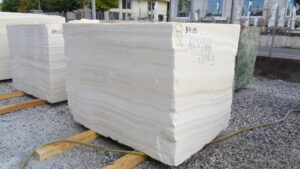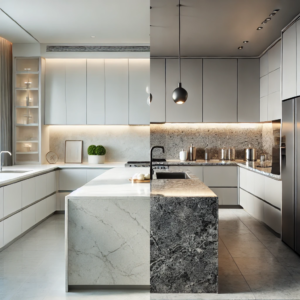


Marble look quartz worktops offer the visual character of veined stone without the routine sealing commonly associated with natural marble. Therefore, they suit households seeking an elegant surface that remains straightforward to clean. However, quartz still needs sensible protection from intense heat, unsuitable chemicals and heavy impacts.
Marble remains a popular countertop material among homeowners, architects and designers. Nevertheless, people who appreciate marble but prefer simpler upkeep may find marble-inspired quartz worktops a practical alternative.
Many homeowners value marble worktops for their natural variation, sophisticated appearance and luxurious character. However, marble can absorb spills without suitable protection. Moreover, acidic substances can etch its surface, while scratches and other signs of use may gradually form a patina.
Why choose marble look quartz worktops?
Engineered quartz combines mineral content with binders and pigments to create a consistent, low-porosity surface. Consequently, manufacturers can produce patterns inspired by Carrara, Calacatta, Pietra Grey and other marbles. Unlike natural stone, however, each quartz design follows a controlled visual concept.
For households that enjoy marble veining but want less routine maintenance, engineered quartz can offer a useful balance. Many kitchen worktop suppliers offer marble-effect patterns with fine, cloudy or dramatic veins. In addition, these quartz worktops generally resist everyday household stains and scratches well when owners use and maintain them correctly.
- Consistent appearance: samples usually give a helpful indication of colour and pattern, although slabs can still vary.
- Simple daily care: engineered quartz does not normally require routine sealing.
- Flexible design: pale or dark veining can complement contemporary, transitional and traditional interiors.
- Practical applications: quartz can suit kitchen runs, islands, utility rooms and selected bathroom surfaces.
Compac Quartz, a Spanish brand, supplied the three designs featured when this article first appeared in 2019. At that time, its Unique Collection included several marble-inspired shades, patterns and finishes. However, collections and formats can change. Therefore, customers should confirm current samples, slab sizes, finishes and availability before specifying a surface.
Three marble-effect quartz designs from the original selection
Marble does not occur only in white. Instead, its colours and markings reflect the minerals and geological conditions involved in its formation. Similarly, quartz manufacturers use pigments and patterning techniques to interpret a broad range of natural stone effects.
The following marble look quartz worktops formed the article’s original shortlist. Together, they illustrate three distinct design directions: soft Carrara character, dark Pietra Grey drama and classic white-and-grey Venatino veining.
1. Compac Unique Carrara
Compac Unique Carrara interprets the restrained appearance of Italian Carrara marble. Because it combines a pale ground with understated markings, the design can support calm kitchens where cabinetry, flooring or architectural details provide the main contrast.
The original product information listed this Compac quartz worktop in 20 mm and 30 mm thicknesses, with slabs measuring 3300 × 1630 mm. However, these figures provide historical context rather than confirmation of the present range. Therefore, a fabricator should verify current formats before preparing plans or quotations.

Visually, this style can work well with white, warm grey, navy or timber cabinetry. Moreover, subtle veining may appear quieter across a large island than a heavily patterned slab. Anyone comparing pale surfaces can also explore MKW’s guide to designing with white quartz surfaces.
2. Compac Unique Pietra
Unique Pietra takes its influence from Italian Pietra Grey marble. In contrast to Carrara-inspired designs, its darker ground and lighter linear veins create a stronger focal point.
The 2019 description listed polished and Glacé finish options. However, customers should examine the selected finish on a physical sample because texture and sheen affect colour perception, reflections and cleaning. In addition, darker surfaces can reveal dust, fingerprints or dried water marks more readily under direct lighting.

This type of marble-inspired quartz can pair effectively with pale doors, natural timber or metallic details. Nevertheless, customers should assess the complete palette under the room’s actual lighting rather than selecting colours from a screen alone.
3. Compac Unique Venatino
Unique Venatino combines a white background with flowing grey veins inspired by Bianco Venatino marble. Consequently, it provides more visible movement than a softly mottled Carrara-style design while retaining a light overall appearance.
The original article described Compac Unique Venatino as containing 93% crystalline quartz pieces with resins. It also listed 20 mm and 30 mm thicknesses and a 3300 × 1630 mm slab format. However, customers should treat those details as historical product information and request current technical documentation before ordering.

Pronounced veins require careful positioning around sinks, hobs, joints and waterfall ends. Therefore, customers should discuss vein direction and seam placement during templating. For additional guidance, MKW’s article about planning kitchen worktop joints explains why layout decisions matter.
How to select marble look quartz worktops
Colour represents only one part of the decision. First, customers should compare a physical sample with cabinet doors, flooring and splashback materials in daylight and artificial light. Then, they can assess whether the scale and direction of the veins suit the available surface area.
Next, customers should ask to see the slab or a suitable image of it where possible. Small samples cannot show the full pattern repeat or the relationship between separate worktop pieces. Moreover, a bold vein may cross a cut-out or end abruptly at a joint unless the layout accounts for it.
- Vein intensity: fine markings create a quieter result, whereas sweeping veins make a stronger statement.
- Background tone: whites may lean warm, cool or grey and therefore affect nearby finishes.
- Edge profile: a simple edge keeps attention on the pattern, while a built-up or mitred edge creates a heavier appearance.
- Finish: sheen and texture influence reflections, colour depth and the visibility of everyday marks.
- Joint plan: slab dimensions, access and worktop geometry determine where fabricators may need seams.
Before preparing a quotation, MKW staff can review drawings, intended applications and finish preferences. In addition, dimensions, cabinet plans and photographs help the team provide more relevant initial guidance.
Care and limitations of marble-inspired quartz surfaces
For routine cleaning, owners should remove spills promptly with a soft cloth, warm water and a suitable mild cleaner. Afterwards, they should rinse away residue and dry the area to reduce streaking. Above all, owners should follow the current manufacturer’s care instructions for their selected product.
Although marble look quartz worktops are durable, they are not indestructible. Therefore, owners should use trivets for hot cookware because sudden or sustained heat can damage resin-bound surfaces. Likewise, chopping boards protect the worktop from knives and reduce unnecessary wear.
Owners should avoid abrasive pads and unsuitable high-alkaline, bleach-heavy or solvent-based products unless the manufacturer specifically approves them. Furthermore, they should protect exposed edges from blows by heavy pans or appliances because sufficient force can cause chips. For more context, MKW’s advice about hot pans and quartz worktops explains safe everyday practice.
Planning templating and installation
Professional templating and fabrication help create accurate cut-outs, suitable overhangs and practical joint positions. Before templating, installers should find secure, level base units, while customers should select sinks, taps and hobs according to the fabricator’s requirements.
Access also affects the installation plan. For example, large islands or long worktop pieces may need extra handling space, while narrow routes may prevent installation in one piece. Therefore, customers should mention stairs, restricted doorways, parking limits and upper-floor installations early in the process.
When requesting a quotation, customers can send MKW a plan and approximate measurements. The team can then discuss samples, fabrication details and installation considerations without assuming that a design featured in 2019 remains available.
Frequently asked questions about marble look quartz worktops
Do marble-effect quartz worktops need sealing?
Generally, engineered quartz does not require routine sealing. However, owners should always follow the care instructions for their specific surface and finish.
Can quartz perfectly copy natural marble?
No. Although quartz can interpret marble colours and veining, natural marble has geological variation that manufactured patterns cannot reproduce exactly. Instead, quartz provides a more controlled appearance and simpler routine care.
Can a hot pan go directly onto quartz?
No. Instead, owners should use a trivet or heat-resistant mat to protect the resin-bound surface from thermal damage and discolouration.
Which marble look works best in a small kitchen?
There is no universal answer. While pale backgrounds and restrained veins can create a calm result, stronger patterns can add character. Therefore, customers should assess samples beside the cabinetry under the room’s actual lighting.
Finally, customers can ask MKW staff for a tailored quotation based on their layout, preferred colour direction and intended use.
Published by Jesus Alberto Mouzo on November 26, 2019