

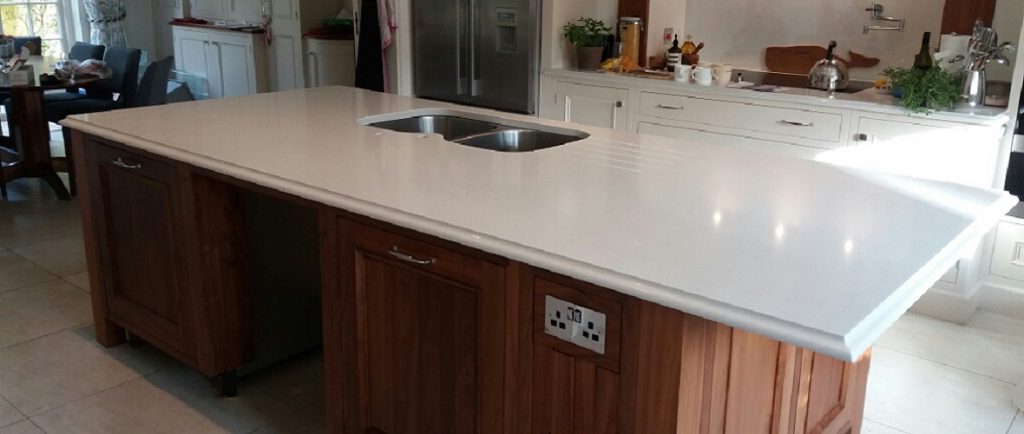
A Carrara marble or quartz worktop can create a bright kitchen with soft grey veining, but the two materials behave differently. Natural Carrara marble offers unique patterns and develops character with use. By contrast, Carrara-effect quartz provides a more consistent appearance, does not normally need sealing and often suits households seeking simpler everyday care.
Therefore, the better choice depends on the household’s priorities. Choose marble if natural variation and authenticity matter most and prompt cleaning feels manageable. Alternatively, consider quartz if stain resistance, predictable patterning and low routine maintenance carry more weight.
Anyone drawn to White Carrara marble should compare full slabs or suitably representative samples before deciding. After all, photographs alone cannot fully show a natural slab’s veining, fissures, tone and finish.

Carrara marble or quartz worktop: the key differences
Carrara marble is a natural stone quarried in the Carrara area of Tuscany, Italy. Historically, its pale background and smoky grey veining have appeared in architecture, sculpture and interiors for centuries. Because nature forms every slab, the colour, markings and mineral features vary.
By contrast, Carrara-effect quartz is an engineered surface designed to interpret that appearance. Manufacturers combine mineral content, binders and pigments to produce slabs with controlled colour and veining. However, composition and performance can vary by product, so buyers should follow the selected manufacturer’s current care and technical guidance.
The term “Carrara” can also describe a visual style rather than a geographic origin when it appears in a quartz product name. Consequently, buyers should not assume that Carrara-effect quartz comes from Italy or contains Carrara marble.
Appearance and natural variation
Natural Carrara marble has depth and variation that an engineered pattern cannot reproduce exactly. For example, veins may flow gently across one slab yet appear denser in another. Moreover, small mineral marks and natural fissures can form part of the stone’s character rather than indicate damage.
Quartz offers greater visual consistency. Therefore, it can help when a kitchen needs several pieces to share a similar background and vein style. Nevertheless, engineered patterns may repeat, while joins can interrupt prominent veins. As a result, careful slab layout remains important for both materials.
Before fabrication, customers should review the actual marble slab whenever possible. Likewise, quartz buyers should inspect a large display or slab because a small sample may not reveal the full pattern.
Porosity, staining and etching
Marble is porous, so it can absorb liquids if they remain on the surface. Although an appropriate sealer helps reduce absorption, it does not make marble stain-proof. Furthermore, the required resealing interval depends on the stone, finish, sealer and level of use. Therefore, the fabricator should recommend a suitable schedule instead of relying on a fixed general timetable.
Acids create a separate issue. For instance, lemon juice, vinegar, wine and some cleaning products can react with marble and leave dull etch marks. Importantly, sealing cannot prevent this chemical reaction. Although a honed finish may make minor etching less conspicuous than a highly polished finish, it does not remove the risk.
Carrara-effect quartz worktops are non-porous and do not normally require sealing. In addition, they resist many everyday spills well. Even so, prompt cleaning remains sensible because strongly coloured substances or unsuitable chemicals may still mark or damage a surface.
Durability of Carrara marble and quartz worktops
Both materials can serve well in a kitchen when professionals specify, fabricate and maintain them correctly. However, neither surface is indestructible. For example, heavy impacts can chip exposed edges, while poor support around cut-outs can increase the risk of damage.
Scratches and everyday wear
Marble can scratch, particularly when grit or hard objects move across it. Consequently, a frequently used marble worktop may gradually develop a patina of fine marks and etching. Some owners value this lived-in quality. Conversely, others prefer a surface that retains a more uniform finish.
Quartz resists routine scratching, yet knives and abrasive pads can still harm it. Therefore, a chopping board protects both the worktop and knife blades. Moreover, it reduces direct food contact and makes preparation easier to contain.
Heat and sunlight
Natural stone generally tolerates heat better than many resin-bound materials, but sudden temperature changes can still create a risk. Meanwhile, quartz contains binders that may discolour or suffer damage under excessive heat. As a result, MKW recommends trivets for hot pans and heat-producing appliances on either surface.
Direct sunlight may also affect some engineered quartz products over time. This consideration particularly matters near highly glazed areas and for outdoor applications. Therefore, buyers should check the manufacturer’s guidance for the exact product rather than assume every quartz design has the same suitability.
For more detail, readers can consult MKW’s guide to whether it is safe to put a hot pan on a quartz worktop.
Cleaning a Carrara marble or quartz worktop

For marble, wipe spills promptly with a soft cloth. Next, use warm water and a mild cleaner suitable for natural stone. Afterwards, dry the area to reduce streaks. In addition, avoid acidic products, abrasive powders and harsh scouring pads.
Quartz also needs straightforward care. Usually, a soft cloth, warm water and a mild product approved by its manufacturer will handle daily cleaning. However, non-porous does not mean maintenance-free, so households should not leave dried spills on the surface indefinitely.
In both cases, owners should follow the specific supplier’s guidance. After all, product formulations, finishes and warranty conditions differ. Consequently, generic online cleaning remedies may cause avoidable damage.
Design and installation considerations
A Carrara marble or quartz worktop can suit classic, Shaker and contemporary kitchens. Both materials pair readily with timber, neutral cabinetry and metallic fittings. In addition, their pale surfaces can help reflect light in compact rooms.
Choosing the finish and vein layout
Polished marble reflects light and enriches colour, although it may make etching more visible. By comparison, honed marble has a softer, matt appearance but can show oils or handling marks differently. Meanwhile, quartz finishes vary by range, so customers should compare their textures and cleaning requirements in person.
Vein direction deserves attention around islands, upstands, splashbacks and waterfall ends. However, book-matched or continuously flowing layouts may not be possible with every slab or room plan. Therefore, the templating and fabrication team should discuss important focal points before cutting begins.
Those considering a coordinated wall surface can also explore backsplash materials for grey kitchens. Furthermore, MKW’s guide to marble-inspired quartz worktops shows how engineered designs can support different interiors.
Professional templating and support
Accurate templating helps determine joint positions, overhangs and cut-outs. Moreover, cabinets must provide suitable support and stand level before installation. This requirement is especially important around sinks, hobs and narrow sections of stone.
During slab planning, fabricators must assess the natural features in marble. Meanwhile, they must fabricate quartz according to the relevant product guidance. Therefore, customers can request an MKW quotation to compare suitable surfaces, fabrication requirements and installation options for their kitchen layout.
Which material should a UK kitchen choose?
Choose marble worktops when the priority is genuine natural stone, one-of-a-kind veining and a surface that can develop character. However, owners must accept the possibility of etching, staining, scratches and periodic sealing.
Alternatively, choose Carrara-effect quartz when easier cleaning, no routine sealing and greater pattern consistency matter more. Even then, owners should use trivets and chopping boards. Furthermore, they should check whether the selected design suits strong sunlight or any unusual application.
Households that cook frequently but want a pristine appearance may find quartz more practical. Conversely, those comfortable with an evolving patina may prefer marble’s natural depth. Ultimately, neither material is universally better because the right choice reflects how the kitchen will look, function and age.
To make a confident decision, customers should compare large samples under the kitchen’s actual lighting. In addition, they should consider cabinet colours, floor finishes and proposed joint locations. MKW can then provide a project-specific quotation based on the chosen material and layout.
Frequently asked questions
Does Carrara marble always need sealing?
Marble commonly benefits from an appropriate impregnating sealer, but its requirements vary. Therefore, the fabricator should assess the slab and finish before recommending a suitable product and maintenance schedule.
Can quartz look exactly like natural Carrara marble?
Modern quartz can provide a convincing Carrara-inspired appearance. However, natural marble has unique mineral variation and depth, while engineered patterns offer greater consistency. Therefore, viewing a full slab gives the fairest comparison.
Will quartz stain?
Quartz resists many household stains because it is non-porous. Nevertheless, owners should remove spills promptly, particularly strongly coloured or oily substances. Moreover, they should always use cleaning products approved for the specific surface.
Is marble unsuitable for a busy kitchen?
No, but it requires realistic expectations. For instance, prompt cleaning, chopping boards and suitable cleaners help protect it. However, anyone who would find etching or patina frustrating may feel more comfortable with quartz.
Should hot pans go directly on either worktop?
No. Instead, a trivet offers simple protection against concentrated heat and thermal shock. This precaution is especially important for engineered quartz because excessive heat may affect its binders.
Finally, readers can review MKW’s broader guide to selecting stone for kitchen worktops before requesting a quotation.
Originally published by Jesus Alberto Mouzo on 10 September 2019. Subsequently updated by the MKW editorial team.