

Labradorite Blue granite worktops create a dramatic focal point through their coarse crystalline pattern and flashes of blue, green and gold. In particular, this natural stone suits statement islands, bar tops and other feature surfaces. However, each slab varies significantly, so viewing and approving the actual stone before fabrication remains essential.
The stone comes particularly from Madagascar. Moreover, suppliers commonly sell it internationally as granite, although the supplied classification also identifies it as anorthosite under a European standard. Its visual impact can be exceptional; nevertheless, successful use depends on careful slab selection, thoughtful seam placement and skilled fabrication.

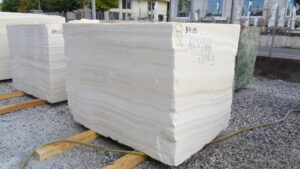
Close view of a Labradorite Blue granite slab.
Labradorite Blue granite worktops at a glance
- Appearance: a coarse-grained surface with a predominantly green to dark background and reflective blue areas.
- Variation: high, with differences in colour, crystal distribution and movement from one slab to another.
- Typical uses: kitchen worktops, islands, bar tops, wall cladding, hearths and selected floor applications.
- Key buying consideration: a small sample cannot represent a whole slab accurately.
- Planning priority: reserve and inspect all slabs needed for the project before templating and cutting begin.
Notably, the reflective mineral areas respond to light and viewing angle. As a result, photographs may look different from the stone in person. Therefore, MKW recommends inspecting full slabs under suitable lighting whenever practical.
Appearance and design possibilities
Labradorite Blue has a distinctive iridescent effect rather than a flat blue colour. As daylight or artificial light moves across the surface, individual crystals may appear brighter or change in intensity. Consequently, the stone works particularly well where a large, uninterrupted area can display its pattern.
For example, a kitchen island can showcase the pattern across a broad surface. Moreover, the stone can provide contrast against plain cabinetry in white, cream, grey, timber or other restrained finishes. Similarly, metallic details can complement the reflective crystals. However, designers should assess physical samples together rather than rely on screen colours.
The material also has several alternative commercial names. Specifically, the original project information lists Labradorite Blue Green, Labradorite Green, Tsoa Pearl, Labradorite Madagaskar and Labradorite Blue Austral. Since naming can vary between suppliers, clients should identify the stone by the approved slab rather than by name alone.
Technical information and verification
The following figures come from the original article’s supplied material data. Therefore, they provide historical reference only and should not replace a current supplier data sheet, test certificate or project assessment:
- Texture: coarse grain
- Main listed colour: green
- Average listed slab size: 2,900 × 1,800 mm
- Classification: granite internationally; anorthosite under the cited European classification
- Slab variation: high
- Listed bending strength: 16.3 MPa
- Listed density: 2,723 kg/m²
- Listed porosity: 0.1%
Importantly, the density unit above appears unusual for material density. Therefore, the supplier or fabricator should verify both the figure and its unit before anyone uses it for engineering or specification work. Likewise, slab dimensions, tile formats and lead times can change. Consequently, clients should confirm them for each enquiry.
The original information associates quarrying mainly with the Ihosy and Ihorombe regions of Madagascar. In addition, it notes related material in Finland, Ukraine and parts of Australia. Nevertheless, commercial names do not always confirm geological identity or origin. For this reason, slab-specific documentation remains important.

Natural rock showing the crystalline character associated with Labradorite Blue Green.
How to choose Labradorite Blue granite worktops
First, examine the entire face of every slab. In particular, look at the distribution of blue flashes, the balance of light and dark areas, and any natural fissures or marks. Fine natural features do not automatically indicate a defect; however, the fabricator should assess anything that could affect cutting, transport or long-term performance.
Next, compare slabs side by side if the scheme needs more than one. Although sequential slabs may offer better visual continuity, they cannot guarantee a perfect match. In addition, discuss which areas will form the island, hob run, upstands and visible edges before fabrication.

Labradorite Blue Green slab with substantial natural pattern variation.
Furthermore, check the condition of slab edges and corners, as they can reveal signs of handling. However, appearance alone does not establish structural quality. Therefore, a professional fabricator should assess reinforcement, cut-outs and vulnerable areas. Clients should also allow enough time for sourcing rather than select from a small sample under pressure.
For broader comparisons, MKW’s guide to choosing the right material for worktops explains the practical differences that can influence a kitchen specification.
Approve the layout before cutting
A digital or physical slab layout helps clients understand where prominent crystals, seams and cut-outs will sit. For example, a sink or hob opening could remove a particularly attractive area. Conversely, careful positioning can place the strongest iridescence across the island’s main viewing side.
Worktop joints also require early planning because slab dimensions, access and cabinet geometry affect their position. Therefore, clients should approve seam locations before production begins. In addition, MKW’s guide to kitchen worktop joint placement outlines the main considerations.
A Labradorite Blue kitchen project

Labradorite Blue Green used as a prominent kitchen surface. [email protected] Lucian Stone in Canada.
MKW previously completed a residential project that used Labradorite Blue as the kitchen’s main feature. Specifically, the commission included 30 mm tops and a rounded island. In addition, the design featured brass inserts fitted flush to the top and stone edges.

Flush brass inserts accenting the rounded kitchen island.

Individual stone pieces aligned with the cabinet doors below.

Completed island showing the curved fabrication and fitted sections.
The design demonstrates how detailed fabrication can turn Labradorite Blue granite worktops into an architectural feature. However, curved sections, inlays and multiple pieces increase layout complexity. Therefore, they require accurate templates, coordinated cabinet positions and clear approval before production.

Hob run finished in Labradorite Blue Green granite.

Brass inserts spanning the six sections of the kitchen island.
For a similarly detailed scheme, clients can ask MKW to review drawings, intended edge details and site access before requesting a quotation. Moreover, providing dimensions and photographs at the outset helps the team assess the project more efficiently.
Care, durability and practical limitations
As a natural stone, Labradorite Blue needs sensible day-to-day care. First, wipe spills promptly with a soft cloth and use a cleaner suitable for natural stone. In addition, avoid abrasive pads and harsh chemicals unless the stone-care product supplier confirms compatibility.
Sealing requirements depend on the particular slab, finish and fabricator’s assessment. Therefore, clients should follow the care instructions supplied with the completed installation. However, a sealing treatment does not make any stone completely stain-proof. Consequently, trivets, chopping boards and prompt cleaning remain worthwhile.
Heavy impacts can damage edges, especially around sink and hob cut-outs. Similarly, thermal shock and concentrated heat may create avoidable risk. Therefore, cookware should rest on a suitable trivet rather than directly on the worktop.
Advantages
- Distinctive natural pattern with strong blue iridescence.
- Each installation has an individual appearance.
- Suitable for statement islands and coordinated feature areas when professionally assessed.
- Can support detailed fabrication, including shaped edges and decorative inlays.
Points to consider
- High slab variation makes sample-only selection unreliable.
- Prominent joints can interrupt the pattern if the layout receives too little attention.
- Natural fissures and crystalline areas need professional inspection.
- Special shapes and inlays can require more complex fabrication and installation.
- Availability, dimensions and lead times need confirmation before the programme is fixed.
Other uses for Labradorite Blue granite
Beyond kitchens, this material can suit bar tops, furniture inserts, wall features and hearths, subject to technical assessment. In addition, related labradorite material appears in jewellery, ornaments and decorative objects. While smaller applications highlight individual reflective crystals, large slabs reveal the broader movement of the stone.

A Labradorite Blue hearth. granite worktops by interior designer Barbara Bright; image by Andrew Mc Kinney.
For a quotation, clients can send MKW their approximate dimensions, plans and preferred design details. The team can then discuss slab selection, fabrication, templating and installation requirements. Crucially, this approach avoids assuming that a photographed slab remains available.
Frequently asked questions
Is Labradorite Blue granite genuinely blue?
The background can appear green, grey or dark, while individual mineral areas create blue iridescent flashes. However, lighting and viewing angle strongly affect how intense those flashes appear.
Can a small sample represent the finished worktop?
No small piece can show the full variation of a large natural slab. Therefore, clients should inspect and approve the actual slabs whenever possible.
Can Labradorite Blue be used for a kitchen island?
Yes, subject to slab assessment and suitable fabrication. In particular, a large island can showcase the pattern effectively. However, its size may require carefully planned joints.
Does Labradorite Blue require sealing?
The requirement depends on the slab, surface finish and professional assessment. Therefore, clients should follow the fabricator’s installation-specific sealing and maintenance advice.
Is every Labradorite Blue slab the same?
No. Instead, crystal size, colour, fissures and iridescence can differ substantially. Although this natural variation contributes to the material’s appeal, it also makes slab approval important.