

Quartz vs limestone worktops is not a choice between two versions of the same material. Instead, engineered quartz offers a consistent, low-maintenance surface, whereas limestone provides the individual markings and mellow character of natural stone. For most busy kitchens, quartz represents the more practical option. However, limestone may suit a project where natural variation and an evolving patina matter more than maximum stain resistance.
Quartz occurs naturally as a mineral, but manufacturers usually create quartz worktops by combining mineral content with binders and pigments. By contrast, limestone is a natural sedimentary stone. Meanwhile, travertine belongs to the wider limestone family, although its open pores and distinctive structure give it a different appearance.
Both materials can create an elegant interior, yet they behave differently in daily use. Therefore, the right choice depends on the room, the preferred finish and the household’s approach to care.
Quartz vs limestone worktops at a glance
- Choose quartz for practicality: it offers low porosity, consistent colouring and straightforward routine cleaning.
- Choose limestone for natural character: every slab can display different tones, fossils, veins and surface variations.
- Consider daily use: limestone needs prompt spill removal and periodic sealing, while quartz still requires protection from excessive heat.
- Compare actual samples: photographs cannot fully show a limestone slab’s variation or a quartz surface’s texture and sheen.
Historically, marble and Granite worktops have served as familiar premium choices. Subsequently, quartz became popular as a practical engineered alternative. Limestone also appears in refined residential and commercial interiors; however, its care requirements mean that it does not suit every kitchen.
1. Appearance and design flexibility
The controlled finish of engineered quartz
Engineered quartz typically provides a more predictable pattern than natural stone. Depending on the selected design, it can offer a largely uniform colour, fine granular detail or prominent veining. Consequently, quartz can simplify the process of coordinating worktops, islands, upstands and other visible sections.
Moreover, this consistency can complement a contemporary kitchen with clean lines. Nevertheless, slabs may still vary between production batches. Therefore, samples should provide guidance rather than act as an exact representation of every installed section.
For further context, readers can consult MKW’s guide to quartz worktops for a broader explanation of the material.
The individual beauty of limestone
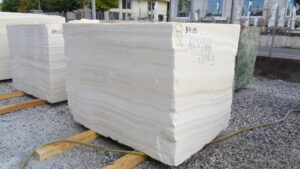
By comparison, limestone often has a softer visual character. Its natural details may include shell fragments, fossil markings, tonal clouds and veins. Because these features form part of the stone rather than defects, buyers should expect one slab to differ from another.
Travertine is a form of limestone and commonly contains visible pores or cavities. Depending on the intended finish and application, fabricators may fill these openings. In addition, limestone and travertine often appear in cream, beige, grey and warmer earth tones, although the precise colour depends on the stone.
A polished surface can intensify colour and reflection. In contrast, a honed finish creates a quieter, more matt appearance. Since the suitable finish depends on the specific stone and intended use, the fabricator should confirm the available options.
2. Quartz or limestone worktops for durability?
How quartz performs in a busy kitchen
Quartz resists many everyday stains because its surface has low porosity. Furthermore, it withstands normal food preparation well. Nevertheless, quartz is not indestructible: heavy impact can damage an edge, abrasive products may affect the finish and excessive heat can harm the resin-based binders.
For that reason, householders should use chopping boards rather than cut directly on the worktop. Likewise, they should place hot cookware on a suitable trivet instead of moving it straight from the hob or oven to the quartz.
Although careful fabrication can create neat seams, joints may remain visible on long runs, large islands or layouts with restricted access. Ultimately, slab dimensions, safe handling and fabrication constraints determine the final joint positions. MKW’s guide to planning kitchen worktop joints explains why seams may prove necessary.
Understanding limestone’s natural limitations
Limestone can provide a durable architectural surface when the specification suits the application. However, it is generally softer and more porous than engineered quartz. Therefore, limestone can scratch, stain or chip more readily in a demanding kitchen.
Acid presents another important consideration. For example, lemon juice, vinegar, wine and some cleaning products can react with calcium carbonate in the stone. Consequently, this reaction may leave a dull mark known as etching. Although a sealer can slow liquid absorption, it cannot prevent acid from etching limestone.
Some owners appreciate the gradual patina that natural limestone develops. Conversely, others prefer a surface that retains a more consistent appearance. Therefore, this distinction should influence the decision when comparing quartz vs limestone worktops.
3. Cleaning and maintenance
Caring for a quartz worktop
Quartz worktops usually need simple daily care. First, the householder should wipe away spills with a soft cloth, warm water and a mild cleaning product that the surface supplier approves. Afterwards, rinsing away residue and drying the area can reduce smears.
However, householders should avoid harsh abrasives, highly alkaline oven cleaners and unsuitable solvents. Moreover, they should not assume that low porosity makes the surface immune to discolouration. Instead, they should remove strongly coloured spills promptly, particularly from pale worktops.
Caring for a limestone worktop
Limestone normally requires sealing after fabrication or installation. Subsequently, its condition and the supplier’s guidance should determine when it needs resealing. Since the stone, finish, sealer and level of use all affect performance, no reliable universal schedule applies to every installation.
For routine care, householders should clean limestone with a soft cloth and a pH-neutral product suitable for natural stone. In addition, they should blot spills instead of spreading them across the surface. Crucially, they should avoid vinegar, lemon-based cleaners, limescale removers and abrasive pads because these products may mark the stone.
Before selecting either material, buyers should request written care guidance for the exact surface. As a result, the household can understand the maintenance commitment before approving a quotation.
Where quartz and limestone surfaces work best
Quartz often suits kitchen worktops, utility areas, vanity tops and other hard-working indoor surfaces. In particular, its relatively consistent appearance can work well across a large island or coordinated run. Even so, the supplier should confirm whether a selected product suits the intended location and exposure.
By contrast, limestone can create attractive vanity tops, fireplace surrounds, reception counters and lower-intensity surfaces. It may also work in a kitchen when the owner accepts sealing, etching and natural ageing. However, the variety, finish, thickness, support and daily demands all influence its suitability.
Neither material choice should rest on appearance alone. For instance, sink cut-outs, tap holes, overhangs, appliance clearances and access routes all affect fabrication and installation. Therefore, professional templating should take place only after installers have positioned level, secure cabinets in their final locations.
Choosing between quartz vs limestone worktops
First, buyers should decide which changes would feel acceptable after several years of use. If stains, etching and patina would prove frustrating, quartz will probably fit the brief better. Alternatively, if natural variation and gradual ageing form part of the desired character, limestone may remain a strong option.
Next, buyers should compare full-size slabs or the largest available samples in the room’s lighting. After all, cabinet colour, artificial light and daylight can alter the way a surface appears. For limestone in particular, slab inspection also helps the project team plan around prominent markings.
Finally, buyers should obtain a project-specific quotation rather than compare material names alone. The total scope may include templating, fabrication, edge details, cut-outs, transport, installation and any required upstands. For a wider decision framework, readers can see the guide to choosing the right worktop material.
MKW can discuss the intended use, preferred finish and layout before preparing a quotation. Moreover, a plan with approximate dimensions and details of sinks, hobs and taps will help the team assess the project.
Frequently asked questions
Is quartz better than limestone for a kitchen?
Generally, quartz is the more practical choice for a busy kitchen because it has low porosity and needs less routine maintenance. Limestone can still work; however, owners must accept sealing, prompt cleaning and the possibility of etching or patina.
Does limestone stain easily?
Because limestone is porous, it can absorb liquids when spills remain on the surface. Although a suitable sealer improves stain resistance, it does not make the stone stain-proof or acid-proof.
Can hot pans go directly onto quartz?
No. Since sudden or excessive heat can affect quartz binders, it may cause damage. Therefore, householders should always use a heat-resistant trivet and follow the care instructions for the specific surface.
Does quartz need sealing?
Engineered quartz does not normally need routine sealing because it has low porosity. Nevertheless, owners should still follow the manufacturer’s or supplier’s cleaning and care instructions.
Should buyers view limestone slabs before ordering?
Where possible, yes. Natural colour, fossils, veins and other markings can vary significantly. Consequently, viewing the slab helps buyers understand that variation and allows the fabricator to discuss the layout.
Making the final decision
In summary, quartz vs limestone worktops involves a clear trade-off. Quartz prioritises consistency, low porosity and convenient care, while limestone prioritises natural individuality and a character that may evolve over time.
Ultimately, the best result comes from matching the surface to real household habits rather than choosing by appearance alone. Once homeowners have narrowed down their preferred material, they can ask MKW for a tailored quotation based on the layout and fabrication requirements.