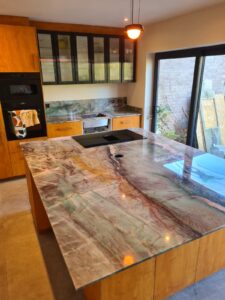



Granite vs quartz vs marble is not a contest with one universal winner. Quartz often suits households that prioritise easy routine care and visual consistency. Meanwhile, granite combines natural variation with strong heat and scratch resistance. By contrast, marble offers distinctive veining for those prepared to accept etching, marks and more attentive care.
Therefore, the right choice depends on how the household will use the kitchen. Colour, finish, slab variation and installation details also matter. Whether a homeowner is planning a new island, replacing an existing surface or pairing a worktop with Howden’s worktop cabinetry, the following comparison explains the practical differences.
Granite vs quartz vs marble at a glance
| Factor | Granite | Quartz | Marble |
|---|---|---|---|
| Material type | Natural igneous stone | Manufactured surface containing mineral material and binders | Natural metamorphic stone |
| Appearance | Natural grains, movement and mineral variation | Consistent designs as well as stone-inspired patterns | Distinctive veining and a classic natural appearance |
| Routine care | Simple cleaning; some surfaces may need sealing | Usually straightforward and does not generally need sealing | Careful cleaning and sealing may be required |
| Heat | Generally strong heat resistance | Hot cookware can damage resin-containing surfaces | Stone tolerates heat, but sudden temperature changes and some finishes still require care |
| Main limitation | Natural variation and possible porosity | Heat sensitivity and less natural variation in some designs | Etching, staining and scratching |
Although this overview helps narrow the options, it cannot replace checking a specific slab or product. Performance differs according to the material, finish and manufacturer guidance. Furthermore, samples show only a small part of a natural slab, so buyers should view the full slab where possible.
Granite worktops: natural variation and robust performance
Granite forms naturally under intense heat and pressure. As a result, its mineral composition creates individual colours, grains and patterns, so no two slabs look exactly alike. This variation gives granite its appeal, especially in kitchens where the worktop should act as a natural focal point.
In practical terms, granite offers good resistance to heat and everyday scratching. Nevertheless, chopping boards and trivets remain sensible because they protect the finish, knives and surrounding joints. Granite also has varying levels of porosity. Consequently, some slabs and finishes need periodic sealing to reduce liquid absorption.
Who should choose granite?
Granite may suit a busy kitchen where natural character and heat resistance rank highly. In particular, it can work well on large islands because broad areas reveal the stone’s mineral movement. However, buyers should accept tonal variation and discuss seam positions before fabrication.
Routine care is usually simple: owners should wipe spills promptly and use a soft cloth with a suitable mild cleaner. In addition, they should follow the fabricator’s sealing instructions rather than relying on a fixed timetable, as different granites absorb liquids at different rates.
Quartz worktops: consistent design and straightforward care
Quartz worktops are manufactured surfaces made from mineral content combined with binders and pigments. However, the precise composition varies, so buyers should consult the current technical information for the product under consideration. Manufacturing allows brands to offer controlled colours, repeated patterns and designs inspired by marble or concrete.
Quartz has low porosity and usually requires no sealing. Therefore, it appeals to households seeking simple day-to-day maintenance. Even so, prompt cleaning still matters, particularly after contact with strongly coloured food, oils or chemicals. Owners should also use products approved by the relevant supplier.
Granite vs quartz vs marble for heat and consistency
Quartz generally offers greater visual consistency than natural granite or marble. Consequently, it can make joins and larger schemes easier to plan, although pattern placement still needs attention. Conversely, anyone seeking completely unique mineral variation may prefer natural stone.
However, heat represents an important limitation. Because quartz contains binders, direct contact with hot pans can cause damage or discolouration. Therefore, owners should always use a trivet. They should also avoid placing heat-generating appliances directly over vulnerable joints unless the supplier confirms that the arrangement is suitable.
Homeowners can compare surface families on MKW’s worktop materials page. For further design inspiration, the guide to choosing a white quartz shade explains how undertones affect a finished kitchen.
Marble worktops: distinctive beauty with greater care needs
Marble forms when heat and pressure transform limestone. As a result, its flowing veins and subtle depth give each slab an individual appearance. Its distinctive character has also made marble a longstanding choice for architecture and interiors. Therefore, it can create a striking island, pastry area or feature run.
However, marble is softer and more chemically sensitive than granite. Acidic substances such as lemon juice, vinegar and some cleaning products can react with its surface. Consequently, this reaction causes dull marks known as etching. Importantly, etching differs from an absorbed stain, and sealing cannot prevent it.
When does marble make sense?
Marble suits homeowners who value its appearance and can accept a surface that develops signs of use. Although prompt spill removal, chopping boards and suitable cleaners will help, they cannot make marble behave like quartz. A honed finish may make minor etching less conspicuous than a highly polished finish. However, the finish choice does not remove the stone’s underlying sensitivity.
Alternatively, some people use marble selectively rather than across the whole kitchen. For example, it can form a feature island while a lower-maintenance surface serves the busiest preparation and sink areas. Those considering natural stone can also explore MKW’s comparison of marble and granite designs.
How to choose between granite, quartz and marble
First, consider daily use rather than colour alone. A household that cooks frequently may value granite’s heat performance, while one seeking simple care may favour quartz. Meanwhile, a design-led project may justify marble’s extra maintenance.
- Consider marks and ageing: decide whether natural variation, patina and occasional imperfections add character or create concern.
- Assess heat exposure: identify where hot pans, countertop appliances and oven trays will sit.
- Review spill risks: wine, coffee, oils and acidic ingredients require prompt attention on any premium surface.
- Plan the pattern: examine full slabs and discuss vein direction, cut-outs, upstands and joins before fabrication.
- Check practical details: cabinet support, sink choice, tap holes and edge profiles all influence the final specification.
- Compare complete quotations: include templating, fabrication, cut-outs, delivery, fitting and any removal work rather than comparing slab material alone.
There is no reliable rule that granite always costs less than quartz or marble. Instead, prices vary with the specific design, slab size, origin, thickness, finish, edge detail and fabrication complexity. Therefore, a project-specific quotation provides a more useful comparison than a broad price ranking.
MKW staff can help clients compare suitable materials, colours and fabrication details. Accordingly, homeowners ready to explore the options can request a tailored worktop quotation.
Granite vs quartz vs marble installation considerations
All three materials need accurate measurement, appropriate support and specialist fabrication. For example, cut-outs for sinks and hobs can create vulnerable areas, while incorrect handling may crack a slab. Moreover, joints, vein alignment and edge details affect the finished appearance.
A professional fabricator normally creates the template after installers have levelled and secured the base units in their final positions. In addition, the fabricator needs the sink, hob and tap specifications before cutting begins. MKW’s worktop process guide outlines the route from project information to installation.
For these reasons, homeowners planning to replace kitchen worktops should avoid treating heavy stone installation as a routine DIY task. Existing cabinets may need assessment, while changes to plumbing or appliances may affect the programme. Furthermore, a professional team can plan safe access, lifting and seam positions.
Frequently asked questions
Which worktop is easiest to maintain?
Quartz usually needs the least routine intervention because it generally requires no sealing. Nevertheless, owners should wipe spills promptly, use trivets and follow the product-specific care instructions.
Is granite better than quartz?
Neither material is better in every kitchen. Granite offers unique natural variation and strong heat resistance. Quartz, however, provides more controlled designs and straightforward care.
Does sealing stop marble from etching?
No. Although a suitable sealer can slow the absorption of some liquids, it cannot stop acids reacting with marble. Therefore, trivets, boards and quick cleaning remain important.
Should buyers view full slabs before ordering?
Yes, particularly when choosing granite or marble. Full-slab viewing helps buyers assess colour, veins, fissures and natural variation. In addition, it supports better planning around cut-outs and joins.
The final granite, quartz and marble comparison
For many low-maintenance kitchens, quartz offers the most practical balance. Meanwhile, granite provides a strong alternative for buyers who want a unique natural surface and good heat resistance. Marble offers exceptional natural character, but it best suits those comfortable with etching, careful cleaning and visible ageing.
Ultimately, the final decision should reflect the actual slab or product, the busiest work zones and the desired finish. To compare options for a specific layout, clients can review MKW’s worktop colour selection and request advice based on their plans.