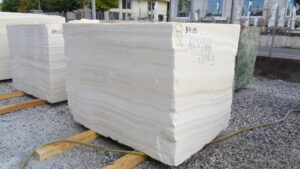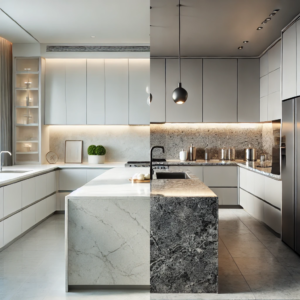


Calacatta and Statuario effect worktops recreate the pale background and expressive veining associated with prized Italian marble. However, manufacturers offer this appearance in several engineered materials, each with different care, heat and installation requirements. Therefore, the right choice depends on more than the pattern alone.
This article first appeared in 2019, when the products below represented notable marble-inspired options. Although the list remains useful as design inspiration, ranges, finishes and availability can change. Consequently, homeowners should confirm current samples and technical guidance before ordering.
What are Calacatta and Statuario effect worktops?
The word marble derives from the Greek “mármaron”, associated with shining or gleaming. Meanwhile, Calacatta and Statuario describe Italian marbles known for light backgrounds and distinctive veining. Although people sometimes use the names interchangeably, each slab can display a different visual character.
Typically, Calacatta-inspired designs feature broad, dramatic veins. By comparison, Statuario-inspired surfaces commonly use defined grey veining against a bright background. Nevertheless, these descriptions indicate an aesthetic rather than a universal specification, so buyers should view a full slab or high-quality image.
Natural marble can develop etching, scratches and stains, while its care requirements depend on the stone and finish. Therefore, anyone considering the genuine material should read MKW’s guide to caring for marble worktops and discuss sealing with a stone specialist.
Quartz, ceramic or sintered marble-effect worktops?
Importantly, marble-look products do not all belong to the same material family. Engineered quartz generally offers a non-porous, consistent surface that suits everyday kitchens. Nevertheless, direct heat can damage resin-based quartz, so users should follow the supplier’s care instructions and use trivets.
In contrast, ceramic, sintered stone and ultra-compact surfaces have different compositions and performance characteristics. Depending on the particular product, they can offer strong resistance to heat, stains and UV exposure. However, impacts may chip exposed edges, so skilled fabrication remains essential.
Alternatively, natural marble offers unique geological variation and an appearance that printed designs cannot reproduce exactly. In return, owners must accept patina and provide more attentive care. For further guidance, the comparison between Carrara marble and engineered quartz explains many of the same practical trade-offs.
Calacatta and Statuario effect worktops from the original selection
Okite Statuario Extra
Okite Statuario Extra appeared in the original article as an engineered quartz design containing 93% quartz. Accordingly, its Statuario-inspired pattern offers a classic pale surface for kitchens seeking a marble aesthetic without choosing natural marble.

Okite Carrara Gioia
Okite Carrara Gioia takes its visual cues from Carrara marble rather than the bolder Calacatta style. As a result, it may suit interiors that need gentler movement and a quieter neutral worktop.

Okite Grigio Oriente
Okite Grigio Oriente has a grey background with fine veining. Consequently, the deeper base colour can create a softer contrast than a bright white surface. Moreover, it can coordinate well with pale cabinetry, timber finishes and understated metallic details.

CRL Calacatta Quartz
CRL Calacatta quartz uses prominent grey patterns to evoke Italian marble. Before ordering any strongly veined surface, however, buyers should inspect the slab layout. After all, vein placement around sinks, hobs, joins and corners can significantly affect the finished result.

CRL Pacific Grey Quartz
CRL Pacific Grey quartz provides a neutral grey alternative to white Calacatta and Statuario effect worktops. Therefore, it may work well where a scheme needs subtle movement without making veining the main feature.

Ceralsio Calacatta Extreme
Ceralsio Calacatta Extreme originally appeared with a creamy beige backdrop and a choice of finishes. Importantly, Ceralsio belongs to the ceramic surface category rather than engineered quartz. As a result, its warmer colouring can complement cream units, natural timber and aged-metal accents.
Additionally, the original list mentioned Ceralsio Cervino as a related marble-inspired design with a crisp white background. Because collections can change, customers should confirm current colours, finishes, slab sizes and availability when requesting a quotation.

Neolith Mont Blanc
Neolith Mont Blanc is a sintered stone surface, not quartz. Visually, its off-white background and fine dark veins produce a restrained stone effect. Meanwhile, the original article compared its appearance with White Macaubas quartzite, although natural quartzite varies from slab to slab.

Dekton Kovik
Dekton Kovik appeared in the 2019 selection as a clean, marble-like design for busy interiors. However, Dekton is an ultra-compact surface rather than engineered quartz. Therefore, customers should check whether this particular design remains available and review current samples before building a scheme around it.
How to choose a marble-look worktop design
First, decide whether the worktop should become the room’s focal point. While broad veins can make an island visually striking, finer patterns usually create a calmer background. Moreover, a sample alone may not show the scale or direction of a pattern, so a full-slab view can prevent surprises.
Next, consider how the pattern will continue through the installation. For example, a fabricator may need to plan joins, upstands, splashbacks and waterfall ends around the slab artwork. Where the selected material and slab format permit it, bookmatching can create symmetry; however, this approach requires careful planning and may use more material.
Finally, compare each quotation on the same basis. Specifically, it should account for templating, fabrication, cut-outs, edge details, delivery and installation. Customers can then request an MKW quotation with plans and approximate measurements before refining the design after professional templating.
Practical care for Calacatta and Statuario effect worktops
- First, wipe spills promptly with a soft cloth and a cleaner approved for the chosen material.
- Likewise, use chopping boards rather than cutting directly on the surface.
- Additionally, place hot cookware on a trivet, especially on resin-based engineered quartz.
- Meanwhile, avoid abrasive pads and unapproved acidic or alkaline chemicals.
- Finally, do not sit or stand on unsupported edges, overhangs or sink rails.
Crucially, care advice varies by manufacturer and material. Consequently, buyers should keep the current product documentation supplied for their worktop. For further context, MKW’s separate guide explains whether users can place hot pans on quartz.
Are Calacatta and Statuario effect worktops right for a kitchen?
Generally, these surfaces suit kitchens that need the elegance of pale marble with a more predictable pattern or a different maintenance profile. In particular, they work well on islands, full-height splashbacks, vanity tops and utility-room surfaces. However, no material is completely maintenance-free or immune to damage.
For a balanced decision, customers should compare physical samples under the room’s lighting and assess how each finish feels. Whereas polished surfaces reflect more light, matt or textured finishes can create a softer effect. Furthermore, availability and finish names may vary, so confirmation at the point of order is essential.
MKW can help customers compare suitable materials and plan the vein layout around a proposed kitchen. To request a quotation, customers should therefore provide drawings, dimensions, preferred colours and details of sinks, taps and hobs where possible.
Frequently asked questions
Are Calacatta and Statuario effect worktops real marble?
Not necessarily. Instead, the terms often describe a visual style used across engineered quartz, ceramic, sintered stone and ultra-compact surfaces. Therefore, customers should check the product documentation to identify the actual material.
Do marble-effect quartz worktops need sealing?
Generally, engineered quartz is non-porous and does not require routine sealing. Nevertheless, owners should follow the specific supplier’s care guidance rather than applying a stone sealer without approval.
Which vein style works best in a small kitchen?
Usually, fine or widely spaced veins can keep a compact room visually calm. However, a bold pattern can still work when the worktop acts as the main design feature and the surrounding finishes remain simple.
Can the veins continue over a waterfall end?
When slab size, pattern and cutting allowances permit it, a skilled fabricator can plan vein alignment across adjoining pieces. Therefore, customers should discuss this detail before templating and approve the proposed layout.
Originally published by Jesus Alberto Mouzo on 8 July 2019. Subsequently updated to clarify material categories and provide current selection guidance.