


Choosing granite kitchen worktops involves more than finding an attractive colour. Households should also consider slab variation, finish, edge profile, joints, maintenance and daily use.
Granite can provide a durable and distinctive surface for preparing food, dining and entertaining. However, natural stone does not offer the complete uniformity of a manufactured product. Instead, individual veining, mineral deposits and tonal changes form part of its character. Therefore, buyers should view the relevant slab or an accurate representation whenever possible.
Why consider replacing existing kitchen worktops?
A new surface can refresh a kitchen without requiring new cabinets. It may also support a larger sink, different hob or new island. Before Replacing Kitchen Worktops, however, the installer should assess the cabinets, services and surrounding finishes.
Granite may suit projects that require the following features:
- A distinctive natural appearance: each slab has its own colour, pattern and mineral detail.
- A hard-wearing surface: granite generally handles everyday kitchen use well with appropriate care.
- Long-term design appeal: neutral granites can complement many cabinet and flooring styles.
- A made-to-measure result: fabricators can form cut-outs, edge profiles and other details for the layout.
- A coordinated renovation: matching upstands or splashback sections can create a consistent finish.
A quality worktop can contribute to a kitchen’s appeal. Nevertheless, no material can guarantee a rise in property value. Location, condition and buyer preferences also influence a home’s market position.
Choosing granite kitchen worktops for the design
Granite ranges from consistent, fine-grained surfaces to dramatic slabs with strong movement. Consequently, the right choice depends partly on the room’s other design features.
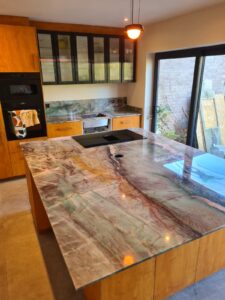
Colour, pattern and natural variation
Dark granite can create contrast against pale cabinetry. Meanwhile, lighter stone may help a compact room feel more open. Highly patterned slabs often create a strong focal point on an island. Conversely, quieter designs may better suit patterned floors or detailed cabinet doors.
Samples help buyers create an initial shortlist. However, a small sample cannot always show the movement across a full slab. Therefore, buyers should ask how the pattern may flow across long runs, islands and joined sections.
Finish and edge profile
A polished finish reflects light and usually creates a rich, glossy appearance. By comparison, other finishes may produce a softer or more textured effect. However, available options depend on the stone and fabrication requirements.
Edge details also influence the final appearance. For example, a simple profile can suit a contemporary kitchen. In contrast, a decorative edge may complement traditional cabinetry. Nevertheless, the final choice must also account for practical fabrication limits.
How durable is a granite kitchen worktop?
Granite is a hard natural stone that generally resists scratches and heat well. Even so, MKW recommends using chopping boards rather than cutting directly on the surface. This habit protects the worktop finish and knife blades.
Likewise, trivets provide a sensible barrier beneath hot cookware. Granite can tolerate heat, but sudden temperature changes may create avoidable risks. Moreover, careful habits help protect nearby joints, sealants and fittings.
Stains, sealing and everyday hygiene
Some granite varieties absorb more liquid than others. As a result, sealing requirements vary between stones and finishes. Buyers should therefore follow the fabricator’s guidance. They should not assume that every granite needs the same sealing schedule.
Promptly wipe away oil, wine, coffee, acidic liquids and strongly coloured foods. For routine care, use warm water, a soft cloth and a suitable mild cleaner. Moreover, avoid abrasive pads and harsh chemicals unless the care guidance approves them.
A clean, well-maintained surface supports good kitchen hygiene. However, granite does not replace normal food-safety practices. Therefore, households should always remove spills and food residue promptly.
Choosing granite kitchen worktops for a replacement project
Replacement worktops require more planning than simply exchanging one surface for another. Stone is heavy, so the cabinets must provide suitable support. Existing units should therefore be secure, level and ready before templating.
The project team should confirm the following details:
- the positions and specifications of the sink, taps and hob;
- whether appliances, cabinets or plumbing will change;
- the required cut-outs, drainer grooves and tap holes;
- the proposed positions of joints and supports;
- the edge profile and any exposed ends;
- whether upstands, sills or splashback sections form part of the design; and
- safe access from the delivery vehicle to the kitchen.
For broader planning advice, readers can consult MKW’s guide to replacing kitchen worktops step by step. In addition, the guide to kitchen worktop joint positions explains why seams may be necessary.
Templating, fabrication and installation
First, accurate templating records the dimensions and relevant features of the prepared kitchen. Next, fabrication turns those measurements into the required stone sections. Finally, installers position the pieces, complete the joints and check the fit.
Cabinets, end panels and supports should normally be complete before templating. In addition, the team needs the final sink and appliance details. Cut-out requirements can vary between models. Consequently, late design changes may affect the fit or installation plan.
MKW staff can review the layout, material choice and fabrication details before preparing a tailored quotation. Providing initial dimensions or a kitchen plan helps the team understand the project. However, final measurements remain subject to the appropriate project process.
Granite compared with other worktop materials
Granite appeals to buyers who value natural variation and the depth of genuine stone. By comparison, engineered quartz often provides more consistent patterns. Meanwhile, porcelain and sintered surfaces offer different design and performance characteristics.
No single material suits every household. For example, a client seeking high visual consistency may prefer an engineered option. Conversely, someone wanting unique natural variation may favour granite. MKW’s guide to choosing the right worktop material offers a broader comparison.
Important limitations when selecting granite worktops
Choosing granite kitchen worktops should include an honest assessment of their limitations. Natural colour and pattern variation may not match a small sample exactly. Moreover, long runs and complex layouts may require joints. Patterns will not necessarily continue seamlessly across those joints.
Granite is also heavy and requires suitable handling and support. Although it is hard-wearing, a severe impact can chip an exposed edge. Furthermore, some stones may need sealing. All granite also benefits from prompt spill removal and suitable cleaning products.
These points do not make granite unsuitable. Instead, they show why informed selection and careful fabrication matter. Professional installation is equally important. Buyers can view completed stone installations in MKW’s project portfolio.
How to request a useful granite worktop quote
A quotation becomes more useful when it reflects the proposed design. Therefore, clients should provide a plan or approximate dimensions where possible. They should also include the preferred granite, edge details, cut-outs, upstands and installation location.
It also helps to identify a full renovation or a worktop-only replacement. MKW staff can then highlight any details that still need confirmation. Afterwards, the team can discuss the appropriate next steps.
When comparing quotations, clients should check the included services rather than only the total. For example, they can confirm whether the scope includes templating, fabrication, cut-outs, delivery and installation. Additional stone features should also appear clearly. Clients may also consult the guide to finding granite worktops in Essex and Surrey.
FAQs about choosing granite kitchen worktops
Does every granite worktop need sealing?
Not necessarily. The stone’s absorbency and finish influence its care requirements. Therefore, clients should follow the advice supplied for their selected material. They should also check suitability before applying any treatment.
Can hot pans go directly on granite?
Granite generally offers good heat resistance. However, MKW recommends using a trivet to reduce risks from sudden temperature changes. A trivet also protects nearby joints and sealants.
Will the installed granite match a sample exactly?
Natural granite varies in colour, mineral detail and pattern. Therefore, a sample helps with shortlisting but may not represent a complete slab.
Can granite fit around an existing sink and hob?
It may be possible, but the fabricator needs accurate product information. Cabinet condition, support, access and cut-out positions will also influence the design.
Where should joints go in a granite worktop?
Joint positions depend on slab dimensions, access, cut-outs, support and the kitchen layout. Therefore, the fabricator should plan them before production. The team should also explain their likely appearance.
Planning the next step
Successful Granite Worktops for Kitchen projects balance appearance with practical details. In particular, clients should review slab character, care guidance, proposed joints and installation requirements.
Ultimately, choosing granite kitchen worktops with professional guidance can produce a durable and individual surface. Households can ask MKW staff for a quotation based on their layout, preferred design and project requirements.