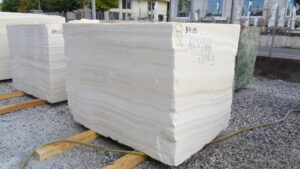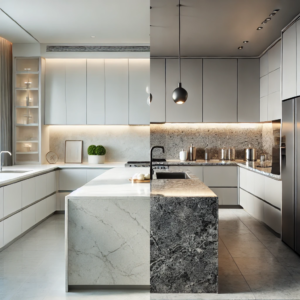



Calacatta quartz worktops offer the appearance of strongly veined Italian marble alongside the consistent finish and straightforward care associated with engineered quartz. Therefore, they suit kitchens, utility rooms, vanity tops and selected interior wall applications. However, buyers should compare full slabs, plan vein positions and check current technical information before ordering.
Manufacturers create these surfaces by combining quartz minerals with binders, pigments and other ingredients. As a result, the finished surface is an engineered material rather than natural Calacatta marble. Consequently, its pattern does not develop through geological processes, even when the design closely resembles natural stone.
How to choose Calacatta quartz worktops
First, assess the overall pattern rather than relying on a small sample. Some designs use broad grey veins, while others introduce fine lines, warmer backgrounds or gold-toned details. Although a sample helps with colour matching, only a full-slab image or physical slab shows the scale and direction of the pattern.
Next, consider the kitchen layout. For example, vein placement can affect islands, upstands, splashbacks and waterfall ends. Therefore, the fabricator should discuss joins, cut-outs and pattern flow before production. Moreover, slab dimensions matter because a suitable format may reduce joins and material waste.
- Colour: compare the surface with cabinet doors, flooring and lighting under real room conditions.
- Pattern: decide whether the worktop should form a bold focal point or provide restrained movement.
- Finish: compare polished and matt options because the finish can alter both appearance and daily cleaning.
- Layout: review the likely position of veins around sinks, hobs, corners and end panels.
- Supply: confirm the current slab format, thickness, finish and care guidance for the selected product.
Finally, homeowners and designers should review the scope of every quotation. For a project-specific assessment, they can check what a detailed kitchen worktop quote should include before requesting estimates.
Benefits and limitations of Calacatta-effect quartz worktops
Calacatta quartz surfaces provide a repeatable marble-inspired design and do not require the routine sealing commonly associated with many natural stones. Furthermore, their low-porosity surface makes everyday spills easier to manage. In addition, the wide choice of vein styles supports both classic and contemporary interiors.
Nevertheless, engineered quartz is not indestructible. For instance, direct contact with very hot cookware may damage the resin content, so users should always use a trivet. Likewise, strong chemicals and abrasive cleaners can affect the finish. Moreover, heavy impacts around edges and cut-outs may cause chips.
Meanwhile, pattern repetition can distinguish quartz from natural marble. Joins may also remain visible, especially where bold veins meet. For that reason, careful templating and fabrication matter as much as the chosen design.
Calacatta quartz compared with natural marble
Natural Calacatta marble offers unique geological variation, depth and irregular veining. In contrast, engineered quartz provides greater visual consistency and usually requires simpler routine care. However, neither choice is universally better because the right surface depends on the desired character, maintenance expectations and application.
For further comparison, readers can consult MKW’s guide to the differences between white marble, granite and quartz. Alternatively, the separate granite and quartz comparison covers broader practical considerations.
Historical Calacatta quartz range in the UK
The following list reflects products and specifications described in the original article, which first appeared in 2018 and received additions in 2019. Therefore, it serves as a historical record of the Calacatta quartz market rather than confirmation of current availability. Since collections, dimensions and finishes can change, buyers should verify every detail with the relevant supplier before specifying a surface.
-
Silestone Calacatta Gold
Originally, the article described Eternal Calacatta Gold as a white design with prominent veining and delicate warm details. At publication, the stated slab size was 3250 × 1590 mm, with 12, 20 and 30 mm thicknesses and Polished or Suede finishes.

Design shown by Suchi Redd.
-
Silestone Bianco Calacatta
Similarly, this 2018 Eternal Collection addition used a bright white background with broad grey veining. Historically, the specifications listed 3250 × 1590 mm slabs, three thickness options and Polished or Suede finishes.

-
Compac Unique Calacatta
Meanwhile, the article highlighted this Spanish-manufactured design for its prominent marble-style pattern. At that time, its listed Giant slab measured 3300 × 1630 mm, with 20 and 30 mm thicknesses and Polished or Glace matt finishes.

-
Caesarstone Calacatta Nuvo
Calacatta Nuvo combined a pale base with flowing veins. Historically, formats included a 3060 × 1440 mm standard slab and a 3330 × 1660 mm Jumbo slab, plus polished and honed finishes. Consequently, the larger format could help reduce joins in some island layouts, subject to templating.

-
Silestone Classic Calacatta
By comparison, this design offered subtler veining than the Gold version. The original specifications gave a 3250 × 1590 mm slab, 12, 20 and 30 mm thicknesses, and Polished or Suede finishes.

-
Unistone Calacatta Toscane
The historical description presented Calacatta Toscane with Polished, Velluto matt and Letano textured-satin options. In addition, the listed slabs measured 3050 × 1400 mm in 20 or 30 mm thicknesses.

-
Cimstone Calacatta Venato
This Turkish-manufactured 2018 design paired a white base with substantial grey and gold-toned veins. At the time, it came in a polished finish, 20 or 30 mm thicknesses and a 3100 × 1600 mm slab.

-
Quartzforms Soul Calacatta
The source described Soul Calacatta as containing 92% quartz crystals alongside resins and other raw minerals. Furthermore, its listed polished slabs measured 3200 × 1640 mm and came in 20 or 30 mm thicknesses.

-
Classic Quartz Calacatta Milan
Calacatta Milan provided a white, marble-inspired appearance. Historically, the listing specified 3050 × 1600 mm slabs in 20 and 30 mm thicknesses. In addition, bookmatched designs allowed adjoining panels to create mirrored patterns.

-
Classic Quartz Calacatta M01
By contrast, M01 featured broader veining than Calacatta Milan and offered a more pronounced visual character. The article listed a 3200 × 1600 mm slab, which could support larger panels where the final template permitted.

-
Classic Quartz Stone Calacatta Lusso
Calacatta Lusso used a bright backdrop with marble-style veining. According to the historical listing, its format measured 3050 × 1600 mm, with 20 and 30 mm thickness options.

-
Stone Italiana Calacatta Oro
Stone Italiana, a Verona-based company producing composite surfaces since 1979, offered Calacatta Oro with grey veining and touches of gold and black. At the time, the article suggested it for worktops, walls and floors. However, buyers should follow the manufacturer’s current guidance for each application.

-
Stone Italiana Calacatta
This alternative combined an opaque white ground with substantial light-grey veins and darker accents. Nevertheless, as with every historical entry, buyers must confirm current formats and suitable uses.

-
Opal Calacatta Gold Quartz
The source described Opal Quartz as containing 93% natural quartz. In addition, it listed 3100 × 1600 mm slabs for bathrooms, floors, splashbacks and quartz worktops. Finally, named variations included Opal Calacatta Gold, Opal Calacatta Ouro and Opal Calacatta Classic.

-
CRL Calacatta Quartz
Launched in spring 2019, this design used grey veins over an antique-white background. Originally, the article proposed kitchen, bathroom and fireplace-surround applications. However, users should check current technical guidance, particularly around direct heat and installation clearances.

Installation and care for Calacatta quartz worktops
First, installers should template the worktops after the cabinets sit level, secure and in their final positions. The fabricator can then assess support, overhangs, access and seam locations. In addition, the project team should agree the vein layout before cutting, especially for islands and waterfall ends.
For daily care, owners should wipe spills with a soft cloth, warm water and a mild cleaner suitable for quartz. Meanwhile, they should avoid harsh chemicals, scouring pads and direct cutting on the surface. Likewise, chopping boards and heat protection help protect the worktop. Above all, owners should follow the care instructions supplied with their particular product because formulations vary.
For further inspiration, those planning a marble-style scheme can explore more marble-look quartz design ideas. Alternatively, MKW staff can review plans and prepare a quotation based on the chosen surface, dimensions, cut-outs and installation requirements.
Calacatta quartz video
Originally published by Jesus Alberto Mouzo on 23 October 2018.
Frequently asked questions
Do Calacatta quartz worktops need sealing?
Generally, engineered quartz does not need routine sealing. However, owners should follow the current care instructions for the selected brand and finish.
Can Calacatta quartz withstand hot pans?
No one should place hot pans directly on quartz. Instead, users should choose a heat-resistant trivet because sudden or prolonged heat can affect the binders and finish.
Can a Calacatta quartz island be made without a join?
Possibly, but the answer depends on the slab size, island dimensions, access route, cut-outs and fabrication plan. Therefore, a survey and template must confirm what is practical.
How should buyers compare Calacatta designs?
First, buyers should review full slabs rather than relying only on small samples. Then, they should compare the background tone, vein scale, pattern flow, finish and proposed position of seams.
For tailored advice, clients can send MKW their plans and request a worktop quotation. Ideally, they should provide cabinet dimensions, an island plan, sink and hob details, edge preferences and the project postcode so the team can assess the work accurately.
Related Calacatta and worktop guides
- What are the differences between Silestone marble colours Calacatta Gold, Silestone Calacatta Classic, and Silestone Bianco Calacatta from the Eternal Collection?
- Compac Unique Calacatta: Get this must-have Quartz Worktop before it’s sold out again!
- Consider Pros & Cons of Marble Worktops before Installing
- The Top Winter Kitchen Worktop Trends For 2021
- Dazzle up Any Project with Exotic Quartzite worktops